
From Windmills to Semiconductors: A Dutch-Led Debate on Industrial Policy
The European Macro Policy Network (EMPN) aims to foster dialogue on fiscal, monetary, and economic policy across Europe. The EMPN connects think tanks and research institutions from Germany, Sweden, France, the Netherlands, Austria, Italy, and Finland. Led by experts with both academic and ministerial experience, the EMPN serves as a platform for linking national debates to broader European challenges, developing joint proposals to improve Europe’s macro-financial framework for a more sustainable, prosperous, and sovereign Europe.
As with our previous conferences in Rome and Vienna, the first day in The Hague was open to EMPN members only. It provided an opportunity to deepen relationships, share work updates, develop joint projects, and strategise next steps for the network’s growth and impact. We extend a heartfelt thanks to our Dutch partners at the Instituut voor Publieke Economie (IPE), particularly Jasper van Dijk, for their warm hospitality and for facilitating productive discussions.
The second day focused on the resurgence of industrial policy amidst geopolitical turbulences. Special thanks to the Ministry of Finance of the Netherlands for co-organising and hosting this public conference. After welcome speeches from Gijs van der Vlugt, Director of General Financial and Economic Policy at the Dutch Ministry of Finance, and Dezernat Zukunft Managing Director Philippa Sigl-Glöckner, the day began with a keynote from Daniel Gros, Director of the Institute for European Policymaking at Bocconi University and decades-long CEPS director. Slides can be found here.
“Europe is trapped between Giants”
Daniel Gros highlighted that Europe’s focus on traditional industries, like machinery and automotive, has left it trapped in a “mid-tech” position, where competition is growing fiercer. While China uses subsidies and its vast domestic market to scale up these same mid-tech industries, the US dominates both raw materials (grains, shale gas, and oil) and high-R&D sectors like software and artificial intelligence, which generate high-profit margins. Europe’s future, Gros argued, hinges on developing its industrial base – and the jobs that come with it – towards high-tech, niche sectors.
Rather than subsidising large, capital-intensive projects like semiconductor fabs, where China holds a clear advantage due to its scale and resources, Gros advised Europe to leverage its engineering expertise in high-tech, low-quantity manufacturing products. A prime example is the success of the Dutch company ASML, which holds a monopolistic position in the semiconductor value chain by producing the world’s most advanced machines for semiconductor manufacturing. ASML’s growth was supported by decades of Dutch industrial policy, illustrating how strategic government backing can foster global leadership.
To achieve this, Gros called for improved EU innovation policies, including strengthening the European Innovation Council and increasing the EU’s R&D&I budget. He also emphasised the need to reduce the cost of failure for high-tech ventures, to facilitate access to and the supply of high-risk capital, and ensure that state aid supports both R&D and human capital development – never just hardware. By focusing on high-tech sectors, Europe can move up the value chain and reduce its vulnerability to global pressures from China and the US.
“Europe lacks long-term vision”
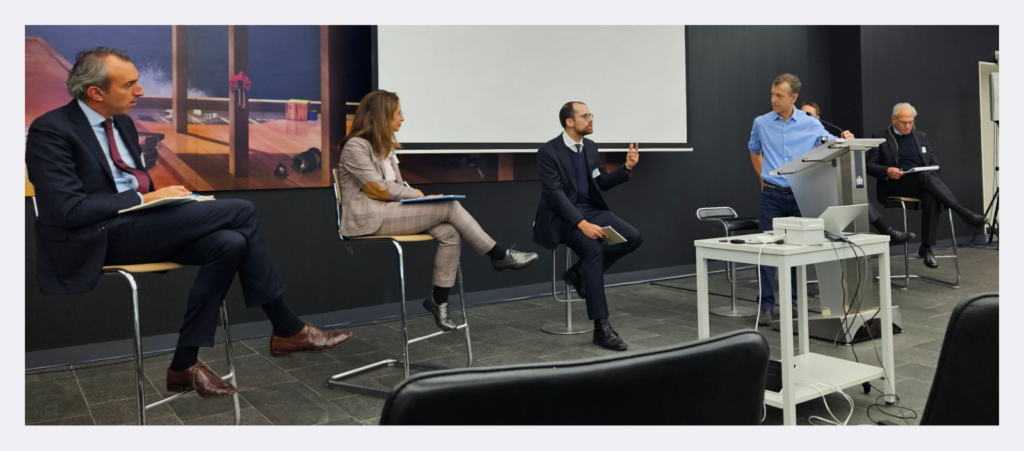
The panel discussion that followed highlighted the need to boost European productivity – in part by growing new, high-tech sectors –, promote innovation, decarbonise, and bring industrial policy back to the forefront of the EU’s agenda after years of neglect. However, opinions differed on the best path forward. Managing the decline of older industries was seen as vital for maintaining public support for new innovation-focused policies. A major critique was Europe’s lack of long-term vision. While the EU Economic Security Strategy focuses on “Protecting, Promoting, and Partnering”, some panelists called for adding a fourth pillar – “Planning.” This would involve strategically supporting high-potential sectors like digital and clean technology and high-tech manufacturing to drive sustainable growth.
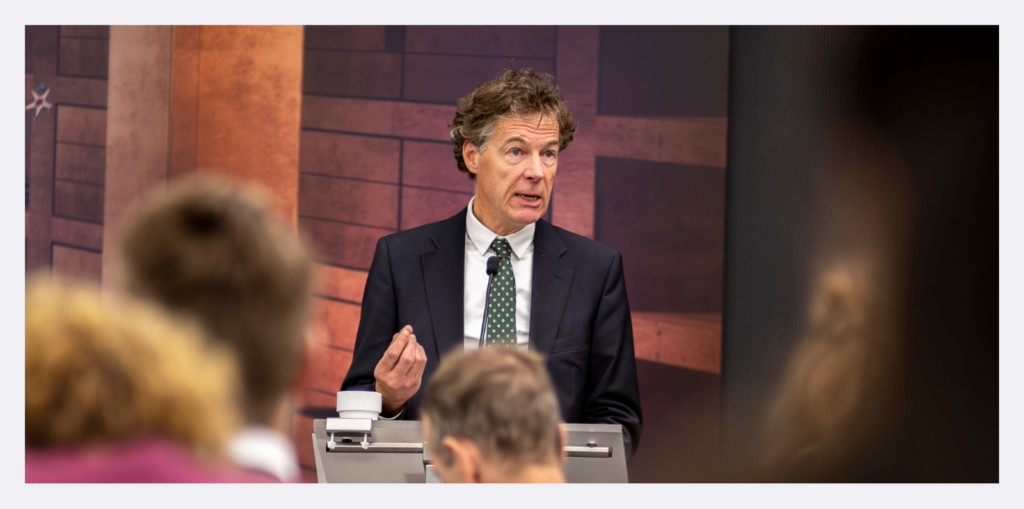
After lunch, Jasper Wesseling, Treasurer-General at the Ministry of Finance of the Netherlands, delivered a keynote address on the emerging Dutch approach to European industrial policy in response to global shifts.
“More state capacity is needed”
The second panel, chaired by Heleen Uijt De Haag from the Dutch Ministry of Finance, emphasised the need for coordinated European action to stay globally competitive while transitioning to a low-carbon economy. The discussion highlighted the lack of state capacity and the importance of attaching clear conditions to state support. Drawing on the success of the US Inflation Reduction Act, which attracted $5 of private investment for every $1 of public funding, the panel suggested Europe should pursue similar crowding-in outcomes using tools suited to its legal framework. Demand-side measures, such as strategic public procurement, were also identified as essential to driving the energy and industrial transition.
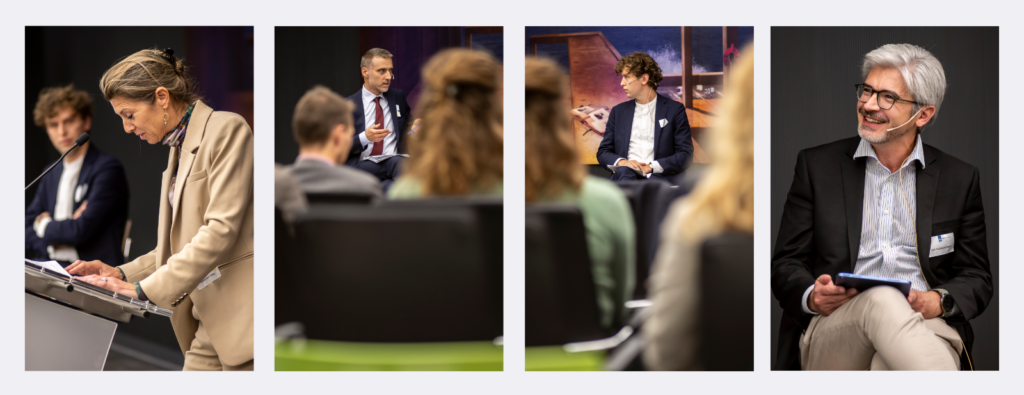
“European coordination is key”
The day wrapped up with two insightful sessions. In the first, Robin Schindowski (Bruegel) examined the strengths and weaknesses of China’s industrial policy, noting that despite its impressive success, China’s heavy public investment is undermined by clientelism and regional protectionism. While the EU’s strong institutional framework avoids these pitfalls, Schindowski warned that picking the right sectors is both crucial and difficult, and that pouring support into sectors already prioritised by China would be a mistake.
In the second session, Reinhilde Veugelers (KU Leuven, Bruegel) highlighted how better European coordination could boost competitiveness. She identified two key disadvantages compared to the US: higher energy costs and a fragmented internal market. To address these, Veugelers called for deeper integration of the single market and sector-specific cooperation backed by EU funding. She pointed to improved energy policy coordination to reduce costs and volatility and outlined key design elements for an effective EU Advanced Research Projects Agency (ARPA) to drive innovation.
The debate will continue within the EMPN
The third EMPN conference was a timely and impactful event, tackling Europe’s industrial policy challenges head-on. The discussions underscored the urgent need for Europe to rethink its sectoral specialisation, embrace innovation and coordination, and adopt a long-term vision to remain competitive on the global stage.
In the coming months, the EMPN will continue to connect European economic challenges with national political realities. Since our first meeting in Rome 18 months ago, the network has expanded, with new research initiatives led by our partners and strengthened coordination under Ludovic Suttor-Sorel since March.
Looking ahead, the EMPN is preparing its next steps on European fiscal, monetary, industrial, and innovation policy – stay tuned for more developments.
Our reading recommendations:
- In Dutch: Financiële Dagblad, the Dutch equivalent of the Financial Times, covered our event with a detailed article.
- In French: Our French partner shared insights on what an EU industrial policy should look like.
- From Italy: Our Italian partner published a 200-page report on EU industrial policy, accompanied by a two-day event co-organized with another EMPN member, Sapienza University.
- In English:
- The Draghi report; and interesting takes from Bruegel and CEPS.
- A call by renowned economists to reform innovation policy to help the EU escape the “middle-technology trap.”
- The Antwerp Declaration for a European Industrial Deal – signed by over 1000 organisations.
- A report by Mazzucato and Rodrik on the role of conditionalities in industrial policy.