
Building the Global Euro
Europe issues the world’s second currency, yet still runs on dollars. What would it take to change that?
Executive Summary
The EU is slowly waking up to a new reality: money has become a key site of geopolitical conflict. From its postwar inception, every step towards European monetary integration has involved further dependence on the US dollar. As a consequence, Europe is today extraordinarily dependent on dollar use for investment, trade and settlement. 30% of EU exports and 50% of imports are invoiced in dollars. Dollar dependence makes the EU vulnerable to the weaponisation of the financial system as an instrument of leverage, coercion, and extortion. Due to growing risks and threats of American sanctions, European banks refuse to provide prominent citizens with bank accounts, be they judges at the Hague’s International Criminal Court or an Italian UN Special Rapporteur. The Chinese RMB, meanwhile, has recently surpassed the euro in key metrics. The EU thus urgently needs a strategy for an increasingly multipolar order.
This report sets out a roadmap for building the euro as a global currency. The report highlights powerful network effects and institutional interdependencies that lock-in dollar use in Europe. It also analyses major institutional obstacles for strategic action across the EU’s multi-level governance structures. Reflecting this political economy diagnosis, the report sets out three key steps for building the global euro: An inter-institutional strategy, a Eurogroup+ Internationalisation Taskforce and a Euro Internationalisation Semester.
The world economy currently uses the dollar because everyone does. Europe as a whole would gain from a shift to the euro, but no single firm or government will pay the price of going first or alone. This collective action trap makes purely market-led adjustment either impossible or excessively slow. We believe reducing Europe’s dollar dependence requires a coherent, cohesive and dedicated strategy. Its goal should not be to replace the dollar altogether — no currency will regain the twentieth-century hegemony the dollar or sterling once held — but to give European firms and governments economically viable and efficient euro-based options for invoicing trade, settling payments, issuing debt and holding reserves.
Europe lacks a strategy, but it has the means. Unlike most jurisdictions, the EU already issues the world’s second currency, on the strength of its size, deep financial markets, legal certainty and open capital account. The United States, meanwhile, is busy undermining the dollar’s dominance. Its fiscal position is reckless, domestic institutions and courts are embattled, the Federal Reserve’s independence uncertain and coercive bargains have replaced multilateralism. Still, despite its highly restrictive capital account, China has so far benefited most from the dollar’s retreat.
The EU needs both a plan and clear governance structures. The same interdependence that holds the dollar in place can work for the euro. Once invoicing, settlement and investment begin to move together, each gain lowers the cost of the next, and adoption starts to carry itself. To get there, the EU needs a political push at the highest level from the European Council and the European institutions in charge.
The study documents three obstacles to building the global euro.
First, building the global euro is a whole-of-government task. It requires coordinated action across payments, investment and trade, each a distinct field with its own priorities, where the euro’s global role is at best a secondary concern. Governance of these fields is split across more than two hundred bodies, from EU institutions and national ministries to central banks and regulators. Moving them together requires a political push none of them can give on their own.
Second, the choices involve trade-offs only politics can arbitrate. Re-ordering the EU payment landscape has important implications for banks and domestic financial institutions. Wider international use of the euro raises demand for euro-denominated safe assets. It might also move the exchange rate, and with it European trade flows and the sectoral composition of the economy. Central banks and financial regulators cannot navigate such trade-offs without political guidance, legislative authorisation, and fiscal backstops.
Third, no institution is accountable for euro internationalisation. Past projects had a clear owner: the Commission led the completion of the Single Market in the 1980s, the Council and the Eurogroup steered the response to the sovereign debt crisis. Building the euro’s international role has none. Expertise sits with the Eurosystem, but central banks are unelected and mandated to deliver domestic price stability only, and have been reluctant to set out a vision reaching beyond that remit. Neither the Commission nor the ECB faces meaningful accountability for the global euro.
Key Recommendations
The EU should set out its approach to the future of the global monetary system and the role of the euro. To make progress, we propose three initiatives that require no Treaty change:
- Commit to a euro internationalisation strategy. A report, modelled on the 2012 Report of the Four Presidents, should set out a strategic vision for the euro’s global role. It should be presented to and endorsed by the European Council by the Presidents of the European Commission, the European Council, the Eurogroup and the ECB.
- Create a Eurogroup+ Internationalisation Taskforce (EIT). The taskforce would keep the strategy up to date, drawing on expertise across the relevant policy areas and on staff seconded from the ECB, the Commission, and national ministries of all willing member states. The EIT would anchor the current policy momentum by monitoring progress, identifying gaps, and proposing non-binding guidelines under Article 121.
- Track progress through a Euro Internationalisation Semester (EIS), which is a new part of the European Semester. To ensure accountability, this process should be led by the ECOFIN Council and the Commission, following the regular timetable of the European Semester. It would produce annual, policy-area-specific recommendations, backed by the Commission to build coalitions between institutions and member states..
All three depend on the same discipline: policymakers reporting progress to the European Parliament and national parliaments, and a willingness across institutions to call out incomplete execution.
1. Introduction
In the 1988 sci-fi roleplaying game Cyberpunk, the European Currency Unit serves as the global currency (colloquially referred to as “euro dollar”, “ed” or “eddie”). In the story, the dismantling of US democracy, a sovereign debt crisis and geopolitical mistakes trigger the collapse of the United States. The European Economic Community steps in and uses its well-regulated banking system and single currency to displace the dollar’s hegemonic role. In the year the game came out, 1988, the idea of a common currency was indeed slowly gaining momentum and debates about the purpose of monetary unification were rife. West German Foreign Minister Hans-Dietrich Genscher formally re-launched the idea of a common European currency specifically to ‘reduce dependency on the dollar’ and secure the Community’s ‘scope for monetary policy action’ (Genscher, 1988; see also Emerson et al., 1992).1
These visions from the late 1980s of a European global currency have not been realised. The euro’s international role has not remotely equalled the dollar, despite the EU’s economic and trade significance otherwise rivalling that of the US. Key measures of usage (FX-reserves, OTC-derivatives) remain in line with usage of the pre-EMU member state currencies (see Figures 1 and 2). As a consequence, Europeans rely extensively on the dollar and US-based financial infrastructures for payment, investment and trade. For example, around 50% of EU imports and 30% of its exports are priced in USD (see figures 3 and 4). Spillovers of US financial and monetary policy continue to be felt at regular intervals. US banking crises, FX swings, and Federal Reserve tightening quickly make their presence known in Europe. Smaller reserve currencies challenge the euro and the expansion of the RMB undercuts the euro’s expansion in this domain (ECB, 2026).
The academic literature has extensively discussed the puzzling lack of euro internationalisation and the corresponding dollarisation of the EU. Authors typically trace this outcome to the specific institutional structures of the EU, the “incomplete” nature of the monetary union and its lack of federal structure, which results in relatively small volumes of safe assets and the absence of a centralised executive with geopolitical clout (McNamara, 2008; Cohen, 2012; Ilzetzki et al, 2020). To internationalise the euro, the literature typically suggests that a treaty change is required: a full Fiscal Union or other far-reaching steps towards much deeper institutional, financial, and fiscal integration. EU policymakers continue to suggest that the international role of the euro starts at home with more efforts to complete the monetary union and upgrade its architecture. Although this has recently shifted, the ECB’s official position until 2024 was that the euro’s “international role is primarily supported by a deeper and more complete Economic and Monetary Union (EMU), including advancing the capital markets union, in the context of the pursuit of sound economic policies in the euro area.” (ECB 2024; but see ECB, 2025a and ECB, 2026).
While the incomplete and sui generis nature of the European Monetary Union creates its own difficulties, the past years have also made clear that it is by no means impossible for the EU to make financial policy without integrated institutions such as a single EU treasury.2 Banking regulation and supervision were rapidly harmonised and centralised after the 2008 Financial Crisis. Similarly, the EU has made clear progress in coordinating fiscal policy, both through the European Semester and through ambitious, joint-liability spending initiatives such as NextGenerationEU or European safety nets like the European Stability Mechanism, or the EFSF/EFSM. Ultimately, the very process of European integration has been one of slow but increasing coherence across siloed and divisive policy areas.
This report argues that due to network externalities and loose interdependencies building the global euro requires governance structures for a concerted strategy. The report highlights three institutional obstacles that have stood in the way of effectively pursuing such a strategy: (i) siloed policymaking and lack of whole of government approach, (ii) ineffective resolution of disagreements between institutions and Member States, (iii) lack of institutional anchoring and accountability. Reflecting its diagnosis, the report also proposes institutional solutions to the EU’s dollar dependence. The EU needs (i) a dedicated Euro Internationalisation strategy, (ii) which is implemented by a dedicated Eurogroup+ Internationalisation Taskforce (EIT), and (iii) where accountability is anchored in a Euro Internationalisation Semester.
The report is structured as follows. Chapter 2 sets out the origins and current status of the EU’s dollar dependence. Chapter 3 uses the recent Dominant Currency Paradigm literature to set out key features that drive currency dominance, focusing on network effects and loose interdependencies between very different uses of a currency. Chapter 4 turns to the politics of euro internationalisation and sets out a procedural way forward to execute a unified strategy.
2. The EU’s dollar problem
To understand the EU’s dollar dependence, it is necessary to trace how deeply the EU has always been embedded in the global dollar system. These dependencies create more severe risks for the EU than is often appreciated. Building the global euro will provide the continent with a powerful means of geoeconomic leverage and multilateral clout, while safeguarding the EU’s domestic monetary sovereignty.
2.1. A brief history of the problem
Dollar dependence predates the EU. From its postwar inception, every step towards monetary integration involved further dependence on the US dollar (Murau and Ehlers, 2025). In the 1950s, the European Payments Union used the dollar as the reference currency for settling payments between member states. Under Bretton Woods, dollar convertibility made international payments possible, tying Europe’s monetary system to that of the United States. In the 1960s, an offshore dollar market developed in Europe, as banks began issuing “Eurodollars” – dollar-denominated deposits and loans issued outside the United States. Since then, the international payment infrastructure has been an improvised combination of public and private sector-led initiatives that all had some level of connection with the dollar system and the United States (see e.g., the brilliant recent work of Schenk, 2026). The dollar serves as the interface between Europe’s national currencies.
Monetary unification has thus, from its early attempts in the 1960s, been partially motivated by the desire to make Europe less dependent on the dollar. From the late 1960s onwards, the US started using its structural power in the global monetary system to fund its large budget deficits and, after the 1980s, Reagan tax cuts, and trade deficit (Helleiner, 1996). Already in 1970, the Werner Report’s three steps towards irrevocably fixed exchange rates were, at the same time, steps towards more exchange rate fluctuation with the dollar (EU Council & EC, 1970).
The introduction of the euro in 1999 was meant to be a game-changer, but far too little attention went towards EU dependence on dollar financial and payment infrastructures (van ’t Klooster and Murau, 2026). Through sheer size, the new currency area was thought to usher in a new, multi-polar monetary order (Emerson et al., 1992). In the years that followed, little was done to fulfil that ambition. Wim Duisenberg, the first President of the ECB, set out the ECB’s stance on this matter in 1999. According to him, the central bank should “[a]ccept the international role of the euro as it develops as a result of market forces. To the extent that the Eurosystem is successful in meeting its mandate and maintaining price stability, it will also automatically foster the use of the euro as an international currency.” (Duisenberg, 1999) In 2018, Mario Draghi still echoed these words in the introduction of that year’s International Role of the Euro report: “The international role of the euro is primarily determined by market forces. The Eurosystem neither hinders nor promotes the international use of the euro.” (ECB 2018)
The ECB’s neglect of the international euro set the stage for continued EU dependence and financial instability. When European monetary integration took off, there was no EU-wide payment provider. Visa and Mastercard quickly jumped on the business opportunity. With internet payments, again, no European provider emerged. Because the euro remained a mostly regional currency, European firms and banks continued to use the dollar for their international business. In the years leading up to the 2008 crisis, global European banks had built considerable dollar dependencies to finance global trade, infrastructure, as well as purchasing large volumes of US securities, including securitised subprime mortgages, often taking more risk than their US competitors (Baba et al, 2009; Gorton and Metrick, 2012). They paid for this by borrowing short-term dollar funds in global money markets, funds mostly extended by US money market mutual funds. This extension of global dollar credit by the European banking system came to a grinding halt with the 2008 crisis (typically described as “global”, but more rightly described as a crisis of transatlantic finance by Bayoumi, 2017 and Tooze, 2018). When Lehman Brothers collapsed, the Federal Reserve’s dollar swap lines saved Europe’s banking system from a full-scale collapse.
Figure 4 · Dollar-denominated intermediation and the 2008 crisis
EU banks funded long-term US dollar assets with short-term dollar borrowing.
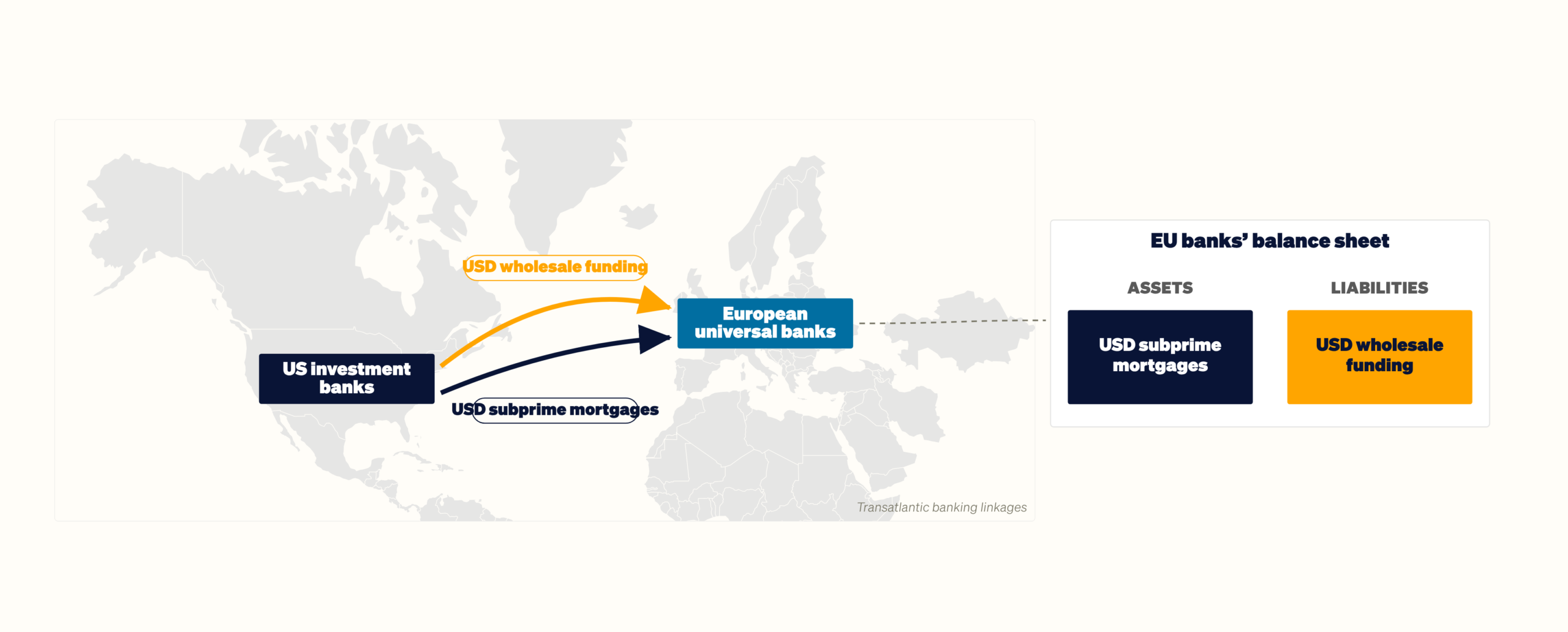
Source: Based on Bayoumi (2017).
Europe’s dependencies reflected a bargain that, for a long time, served both sides well enough (Norrlof, 2010; Buti et al 2026). The United States benefited from what Valéry Giscard d’Estaing called an “exorbitant” privilege: the ability to issue the world’s reserve currency. It could pay for imports by simply issuing credit money. Ample demand for USD liabilities also enabled the emergence of extremely profitable financial and tech sectors. Despite their fragile institutional basis, the Federal Reserve’s swap lines served to stabilise the global financial system in times of crisis. IMF’s loans, overwhelmingly in dollars, and Washington-based expertise were crucial in navigating the EU’s sovereign debt crisis. NATO created a long-term institutional framework that tied Europe to US leadership, softening the sting of dependence.
2.2. What is dollar dependence?
The EU’s dependence on the dollar and US financial infrastructures resists a simple summary, extending far beyond the financial system narrowly conceived. We operationalise dollar dependence in terms of three, relatively easy to measure purposes of a currency: as the currency for settling payments (means of exchange), as the currency to invoice trade (unit of account) and its use to denominate investments and savings (store of value). It is, however, crucial to see dollar use as embedded institutionally in transnational financial infrastructures and, in particular, banking practices, which in turn are subject to complex cross-jurisdictional regulation and supervision.
Settlement and payment dollarisation: Settlement is the transfer of a monetary instrument from a payer to a payee to meet a payment obligation. Intra-European retail payments are today overwhelmingly processed by US payment card networks (Visa, Mastercard) and digital wallets issued by US tech companies such as Apple Pay and PayPal (ECB, 2024). The latter is currently the main method used by Germans to make online payments (Mollie, 2024). However, the dependence on the US for settlement goes deeper and is closely intertwined with the global role of the dollar. Payments between the EU and emerging markets are routinely intermediated via EUR-USD and USD-local currency conversions to exploit the superior liquidity of dollar pairings. This dependence creates further institutional dependencies. European wholesale cross-border clearing with non-EU countries often depends on US correspondent banks and dollar clearing systems (e.g., CHIPS). These systems are slow and costly. They also expose European commercial data and financial flows to US extraterritorial jurisdiction, sanction regimes, and intelligence gathering.
Savings and investment dollarisation: EU residents invest in and issue dollar-denominated assets. They invest in US Treasuries, corporate bonds, equities and bank deposits. European investors hold almost $2 trillion in dollar-denominated treasuries ($3 trillion when including the UK and Switzerland) and about $8.8 trillion in US equities within total holdings of roughly $14.9 trillion in US long-term securities (Mehmedi and Remirez, 2026; US Treasury, 2026). In Europe (including the UK), US treasuries are the most traded asset, while US corporates make up the largest volume of corporate bond trades (ICMA, 2025; ICMA, 2025b; Sigl-Glöckner et al., 2026). Euro area investors allocate roughly equal shares of their equity portfolios to US markets (34%) and domestic markets (35%) (Longaric et al., 2026). European investment funds allocate 50% of their total capital to the United States (Longaric et al., 2026). EU banks also issue dollar-denominated financial products (for example, around 17% of bank funding) and lend in USD (estimated at 9.2% of the total loan book) (Klaus and Mingarelli, 2024; Grodzicki et al., 2025). Thus, EU residents rely heavily on the regulatory architecture of US securities markets, with offshore transactions made possible through European International Central Securities Depositories (ICSDs) and US correspondent banks to clear and settle transactions.
Invoice and trade dollarisation: EU residents buy and sell goods priced in dollars and denominate economic contracts in dollars. Dollar invoicing is particularly pronounced for petrochemical products, but as Figures 6 and 7 illustrate spans the whole range of goods. For primary goods, the USD invoicing rate of 44% reflects global pricing practices at centralised, specialised exchanges (e.g., the London Metal Exchange, the Chicago Board of Trade) for homogenous products such as non-ferrous metals, bulk cereals, tropical agricultural products (e.g. coffee, cacao) and non-petroleum energy such as LNG. The USD share of 51% in imports also reflects the EU’s reliance on the US and Asia for high-tech, aerospace, and digital infrastructure where the dollar acts as the default currency across complex supply chains.
Each of these three ways in which the EU is dollarised reflects existing international institutional embedding and related banking practices (van ’t Klooster and Murau, 2026). Settlements and payments depend on long-standing correspondent banking networks, intraday liquidity facilities (overdrafts) to settle clearinghouse balances, and short-term FX swaps to manage daily cross-currency payment flows (Bindseil and Pantelopoulos, 2022). Investments and savings are sustained by capital market intermediation, which depends on repo markets for secured short-term funding, collateral management services, prime brokerage, and interest rate derivatives to manage duration and portfolio risk (Pozsar, 2014). Trade involves its own specific finance (e.g. letters of credit, supply chain financing, commercial paper) to bridge the temporal gap between delivery and payment, as well as insurance and FX-hedging (Niepmann and Schmidt-Eisenlohr, 2017). Throughout, dollar dependence in a narrow sense is inextricably linked to dependence on US financial infrastructures.
While the three forms of dollarisation are distinct, interlinkages are thus pervasive. For example, to process international payments for EU corporate trade transactions, EU banks hold vast pools of liquid US Treasuries. The use of the dollar for investment purposes thus makes possible its use for payment functions and trade. This means that policies to reduce dollar dependence and internationalise the euro cannot target individual choices to settle, invest or invoice in a given currency, which in any case are often made outside the EU’s jurisdiction. Instead, they must strategically intervene on these institutional embeddings, creating viable alternatives in the form of euro-based transactions.
2.3. Monetary sovereignty today
The EU is slowly waking up to a new reality. It no longer faces a benign hegemon shouldering its exorbitant duty, but rather a new, more transactional administration that treats its currency and the broader dollar system as a tool of leverage, coercion, and extortion.
The EU’s dollar dependence developed in the context of a broadly cooperative transatlantic relationship, but is now a source of vulnerability. As a result, the EU is vulnerable to further weaponisation of US payment infrastructures, new dollarisation policies, and financial stability spill-overs. Conversely, by freeing itself from dollar dependence, the EU will strengthen its ability to set its own course.
2.3.1. Payment weaponisation
The EU’s payment and financial infrastructures are deeply entangled with the US: major card schemes, cloud providers, messaging networks and key software layers are controlled by American corporations. European banks are heavily exposed to US regulatory and sanctions decisions.
Already in 2018, the decision by the Trump administration to leave the Joint and Comprehensive Plan of Action (JCPOA) and reinstate sanctions against Iran forced most European companies to interrupt business with the country. Despite efforts to shield European corporations from US sanctions, European firms complied due to fear of potential retaliation, loss of market access and access to critical US financial infrastructures. Over the last decade, very little has been done to address this vulnerability.
Recent sanctions against the International Criminal Court (ICC) judges or against a former European Commissioner illustrate how far the US is already willing to go, targeting individual policymakers and institutions (Trump, 2025) and how little the EU is responding. Since February 2025, “secondary sanctions” target anyone transacting with the Court with prison sentences of up to 20 years. Although the ICC is based in the Netherlands, the scope of the sanctions is vague, leading risk-averse European firms to avoid the ICC and its staff members. Since European banks rely on access to US capital markets and New York clearing, the ICC and its staff struggle to access basic payment services, even in euros (Maupas, 2026).
2.3.2. Digital currency dollarisation
The US has decided with the GENIUS Act to promote widespread use of dollar stablecoins across the world to boost international demand for the dollar (van’t Klooster et al, 2025). Stablecoins are digital tokens that users can transfer between apps to make payments. The coins are backed by USD-assets such as US treasuries and asset-backed securities, but stablecoins remain risky because the issuer does not hold 100% of its assets in liquid securities.3
As prominent members of the administration now admit, stablecoins are not really meant for US citizens: they “do not offer yield and are not backed by federal deposit insurance” (Miran, 2025). Instead, “[t]he real opportunity in stablecoins is to satiate untapped foreign appetite for dollar assets from savers in jurisdictions where dollar access is limited” (Miran, 2025). This is what Eric Monnet has aptly called “cryptomercantilism”: the use of stablecoins as instruments of statecraft through the expansion of private companies (van’t Klooster et al, 2025.).
Going forward, large US platforms are set to roll out dollar stablecoins across states with weak currencies, marketing the coins through social media, e-commerce and remittance channels. The Trump family itself owns the fifth-largest USD stablecoin, issued via their crypto company World Liberty Financial. Although issuance has been broadly stable in 2026, the ambition of these efforts is for the total issuance of stablecoins to grow from nearly USD 300bn in the summer of 2025 to up to USD 3 trillion by 2030 (Bessent 2025).
Although so far the path of expansion suggests a far more modest trajectory, new USD demand for stablecoins could strengthen the US’s grasp on the world economy, including its ability to coerce other states to align with its national priorities. US tech companies and financial institutions may market stablecoins to EU residents, particularly in non-euro member states. They will certainly push stablecoins in the EU’s immediate neighbourhood. For the states where they are used, stablecoins create involuntary transfers of savings to the US while resulting in domestic payment systems in part controlled by US-based private companies. If successful at scale, this would have the effect of accelerating digital dollarisation.
2.3.3. Financial stability spill-overs
European banks and other financial institutions borrow in dollars and issue other forms of debt in that currency (Klaus and Mingarelli, 2024) to extend credit in dollars and expand their international business footprint. A dollar-centred financial crisis thus also potentially strikes at European banks, investment funds, pensions and other financial institutions. In 2008, large European banks faced a sudden stop in wholesale dollar funding. While their exposure to dollar liquidity has reduced since then, the basic vulnerability is still there. At the time, the activation of the Federal Reserve’s swap lines provided the dollar liquidity that European central banks could not create themselves.
The legal foundations of the swap-line regime, always questionable, look increasingly fragile amidst attacks on the Fed’s independence (Perry, 2020; Menand 2021). The Fed’s legal basis for issuing swap lines rests on the interpretive claim that swaps are not loans to foreign central banks. Such interpretations look vulnerable in a policy landscape increasingly marked by a rejection of broad administrative powers and a claim that monetary policy should be focused on a narrow price stability remit. Seeking to ban all controversial legal interpretations by independent agencies, the Trump administration has, for now and with the implicit blessing of the Supreme Court, exempted the Fed in its “conduct of monetary policy”, but this does not extend to other tasks (Trump, 2025b).
The current administration could treat crisis-access to dollar swap lines as a political favour. Good examples of ongoing politicisation are the US administration issuing a US Treasury swap line via the exchange stabilisation fund to Argentina or the recent request by the United Arab Emirates in response to the Iran crisis. For Europe, blocking access to dollars could be used as a threat, with hard-to-foresee consequences if acted on. European sovereigns and their banks would be forced into emergency liquidations of their USD assets. The EU’s investors would incur losses in such a fire sale and may at times fail to raise sufficient cash. To be sure, such sales would also have clear negative repercussions for the US, as they easily overwhelm the intermediation capacity of US primary dealers: the treasury market would likely crash, and the Fed would need to intervene on an unprecedented scale (Dafermos et al, 2023.). Such a crash would also severely dent the US’s status as a global issuer. Still, the EU’s dependence on politicised swap lines creates a clear vulnerability, which the US could easily exploit for short-term leverage (Sigl-Glöckner et al., 2026).
3. The economics of currency internationalisation
Dollar dependence will not go away simply due to more volatile returns for investors, since it does not rest on returns alone (Pforr, 2025). In the 1970s, dollar use expanded dramatically even as the currency depreciated: since then, returns on dollar debt have generally been more volatile than those of other major Western currencies (Eren and Malamud, 2022).
Weaning the EU off its dollar dependence is not easy, since powerful network effects hold the dollar in place (3.1). Moreover, different uses of money are loosely interdependent, so that measures solely geared towards one field (e.g. payment dedollarisation) will be unsuccessful without corresponding (e.g., trade and investment-focused) measures (3.2). However, the network effects that hold the dollar in place, can also reverse: progress in one field of currency competition also strengthens efforts in others. Shifting denomination behaviour in the EU thus requires concerted action across a wide range of policy fields. Unlike most jurisdictions, the EU has under-appreciated strengths as a currency bloc, if it gets its act together (3.3). It is one of the world’s largest economies, with a particularly sizable trade footprint. It also has large, developed financial markets with a high degree of openness to the world. Finally, and perhaps most importantly, its constitutional structures give it a high level of credibility as a creditor and multilateral partner.
3.1. Incumbency advantage and network externalities
International currency use is first and foremost a market phenomenon. This makes active policy to promote progress in individual policy areas more difficult, in particular in the context of the EU’s liberal economic model. At the end of the day, economic contracts, including the choice of currency denomination, are set by the private sector. Individuals and firms are mostly free to choose the most cost-efficient currency denomination.
The market dynamics of international currency use are characterised by the existence of pervasive network externalities. Europeans use the dollar because their domestic and international counterparties use the dollar. Such network externalities exist both within and between purposes. Consider the three uses again:
Settlement and payment network externalities: The utility of any given means of payment depends on good infrastructures and widespread acceptance, which bring down transaction costs. Widespread acceptance benefits the currency (where liquidity is subject to network effects) and payment infrastructures within that currency (which are subject to technological platform network effect) (Rochet and Tirole, 2003; Evans and Schmalensee, 2005). For an example of the former, most currency trades involve the dollar on one side, often intermediating a transaction between two currencies only used much more rarely (BIS, 2025). International payments are often converted from local currencies to USD, and then from USD to a second local currency, simply because the USD pathways are the cheapest. 89% of all over-the-counter foreign exchange transactions involved the dollar (compared to 29% for the euro) (BIS, 2025b). Because the dollar is so widely used, USD-transactions benefit from very low bid-ask spreads, which in turn creates more use. For an example of technological platform network effects, VISA and Mastercard derive their crucial role in European payment services from their ability to transact payments across the continent. Using the dollar here is cheap exactly because everyone uses the dollar; because everyone uses the dollar, relying on it is cheap.
Savings and investment network externalities: The choice of a currency to invest and issue in is determined by the size and liquidity of markets, giving rise to what economists call a convenience yield on USD-denominated assets (Krishnamurthy and Vissing-Jorgensen, 2012; Gorton, 2017). The depth of the USD financial markets creates safety and instant convertibility that investors are willing to pay a premium for. Because major central banks and asset managers hold dollar assets to manage daily liquidity, the market becomes the most liquid. As a consequence, although investors typically have a strong bias towards investments denominated in their own currency, this is not the case for the dollar (Maggiori et al, 2020).
Trade and invoicing network externalities: firms price in dollars simply because others price in dollars (Gopinath, 2015; Gopinath et al.,2020; Amiti et al, 2022). Following the Dominant Currency Paradigm literature, firms use the dollar as an invoice currency for two types of reasons: (i) strategic complementarities: firms want to keep their prices stable relative to those of competitors, who price in dollars, (ii) input-output linkages in global value chains: firms want to keep their output prices stable relative to the input prices, which are priced in dollar.
3.2. Institutional interdependencies
Crucially, these three uses also benefit from network externalities amongst each other. Such interdependencies are loose since in theory, the different purposes can be distinguished. However, in practice, use of a currency for one function further strengthens its use for others.
Figure 8 · Dollarisation’s three uses reinforce one another
Loose interdependencies between the three uses of a currency.
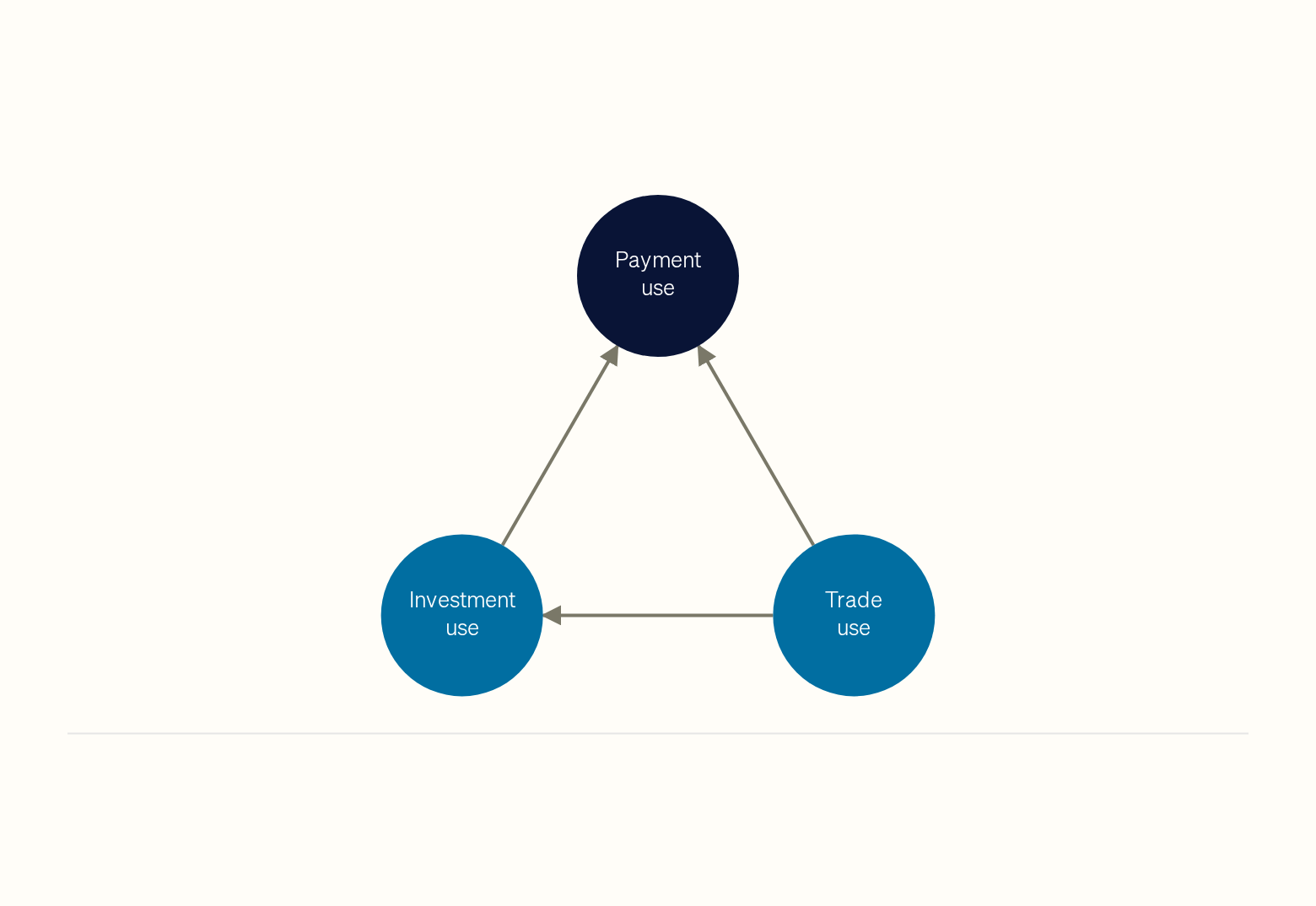
Source: Authors’ own elaboration.
Two interdependencies are crucial (see Figure 8). First, the EU is dependent on the US for payments because its residents use the dollar for investment and trade. Consider the deeper reason for European banks’ vulnerability to secondary sanctions, which reflects their need to settle payments via New York correspondent banks. European banks are tied to New York because they issue dollar-denominated bank deposits to provide financial services to their corporate customers and fund investments in that currency. This interdependence is loose because, in principle, it would be possible to use the dollar to invoice a sale without settling the payment for that sale in New York. For example, China has developed a strategy of derisking its dollar-denominated trade by creating an RMB-denominated settlement infrastructure (see Box 1). This allows firms to settle payments in RMB, while invoicing in dollars. However, this partial success in dedollarisation depends on extensive capital account restrictions and other interventionist policies hard to envisage in an EU-context. The EU is locked into the US’s financial orbit through a complex web of institutions, banking practices and financial infrastructures. An EU strategy of payment dedollarisation, narrowly focused on a digital currency and other means of payment, is thus unlikely to succeed (see Box 2).
The second major interdependence is that between the EU’s investment and savings dollarisation and the use of the dollar for trade. Firms that sell products in dollars will highly likely also want to use the dollar for investment purposes (i.e. hold dollar-denominated bank accounts, receive dollar-denominated trade credit, issue debt) (Gopinath and Stein, 2021). If an EU firm’s assets are valued in dollars, it is likely to issue debt in dollars to avoid a currency mismatch on its balance sheet (Eren and Malamud, 2022). It will also take out trade credit, trade insurance and any financial derivatives for hedging against exposures that result from the trade in dollars. Once a firm has issued dollar-denominated debt, it has an even stronger incentive to invoice its exports in dollars (creating a “natural hedge” to pay off that debt). These interdependencies thus strengthen network effects. Firms issue debt in dollars partly due to the widespread use of the dollar for invoicing and finance. High international demand for dollar-denominated debt, conversely, makes it cheaper and deeper for firms to borrow in dollars, further locking in dollar dominance.
The currency denomination of trade is, accordingly, a major driver of payment and investment uses of currency, as is also clear from historical experience. For example, the US dollar’s international use started with trade invoicing in the 1910s, replacing sterling trade credit during World War 1. To this end, the 1913 Federal Reserve Act set up a central bank to discount trade bills (Broz, 1997; Eichengreen et al, 2018). With the end of Bretton Woods, the US used the invoicing of energy trade to anchor the dollar’s international role. The Marshall Plan resulted in large European oil imports from the US, creating a steady demand for USD assets. Then, in the 1970s, as the US became a net importer of oil, it fostered USD use by pressuring the Gulf states to invoice oil trade in dollars (Spiro, 1999). While today the main focus of EU policy discussion is often on investment purposes (safe assets, capital markets), successful de-dollarisation of trade is crucial.
The gap is widest in the credit that finances trade. At the end of 2020 the euro carried 37% of total Swift payment value against the dollar’s 39%, but only 7% of trade-finance value against the dollar’s 86% (Cipriani et al., 2023). The euro moves payments almost as widely as the dollar and finances almost none of the trade behind them.
These economic dynamics suggest the need for coordinated action across policy fields targeting payment, investment and trade. With a more coordinated strategy in place, however, interdependencies and network effects will also work in favour of the EU: success is self-reinforcing through feedback loops and tipping points. The roots of the EU’s dollar problem are thus deep, but can be overcome through a concerted strategy.
Box 1: The Chinese RMB strategy (Gerresheim et al 2026) The past 15 years China has meticulously executed a strategy to promote the international role of the RMB and reduce its vulnerability to dollar dependence (Eichengreen et al., 2024; Hofman and Petry 2025). Despite its highly restrictive capital account, China has so far benefited most from the dollar’s retreat. Its progress has differed markedly across the three use-cases of an international currency, with success mostly on settlement and to some extent invoicing. China has sought to develop efficient payment infrastructure, such as an offshore clearing-bank network, the CIPS payment system, a central bank digital currency (the e-CNY). The PBoC has also built a vast bilateral swap line network not only to backstop financial friends like that of the Federal Reserve but also to expand the role of the RMB in international trade invoicing and settlement (Bahaj and Reis 2026). China is now offering a fully sovereign and fully public payment infrastructure outside of the reach of US sanctions, which is an extraordinarily valuable asset in an increasingly geopolitically fragmented world. Across these strategies, China made most progress on settlement, with more than half of its own trade now settled in RMB, up from 10 per cent in 2012. Progress on invoicing and investment has been more limited. The RMB has recently overtaken the euro as the second most-used currency for trade invoicing, but the currency is still barely used between third countries. For investment use, China is held back by the shallowness of RMB markets and the split between an onshore market and an offshore RMB market focused on Hong Kong. China maintains a restrictive regime administered by the State Administration of Foreign Exchange, which manages capital flows through quantitative limits, licensing requirements for inflows, time stipulations on outflows, and entire asset classes banned from investment. This makes RMB-denominated assets and liabilities highly vulnerable to political interference. However, the RMB’s inclusion in the SDR basket quietly contributed to making the RMB a more widely used investment currency for global official reserve managers (particularly for some of the large emerging economies’ central banks). Without deep, open, and liquid RMB markets, FX-hedging stays costly and the more fundamental use-cases cannot follow settlement. Lifting these capital controls would force China to reduce its ability to control domestic and external monetary arrangements. These policies are unlikely to change rapidly as they reflect both domestic surveillance objectives and a deep fear of capital flight and foreign weaponisation thereof (Freymann and Heng, 2025). |
3.3. Hidden strengths
International use of currencies changes only slowly, with few historical examples of major shifts to guide our thinking. In an increasingly multipolar monetary order, states will need to make consequential decisions on their currency mix. The EU faces a set of hard choices, but so do many other countries. Unlike other jurisdictions, the EU has a clear path towards developing its currency into an alternative to the dollar.
First, the EU is a large economy with extensive trade relations, broadly comparable to the US and China. It is particularly important as a trading block. 72 countries, together constituting around 40% of world GDP, have Europe as their most important trading partner. The EU also has the largest number of trade agreements.
Since trade is at the core of an effective international currency, the EU’s size as a trading block is a key asset for currency competition. However, the EU could use its trading power more effectively (Vallée, 2025; 2026). Important steps could be taken by pushing domestic firms to invoice in euros, focusing on sectors that are less dependent on dollar inputs, mostly sell to European customers and (as most EU firms do) have euro-denominated wages as their largest input cost. Further incentives for euro use could be created through currency conditions on export credit and insurance, some currency provisions in the EU’s free trade agreements as well as a targeted bilateral swap network of the ECB.
| External portfolio investment (Bonds and equities) | External other investments (Loans etc) | |
|---|---|---|
| EU27, extra-EU (Eurostat) | $17,737,750.4 (15.0%) | $8,727,202.4 (7.4%) |
| US (FRB Saint Louis) | $19,200,196.0 (17.3%) | $6,492,483.0 (5.9%) |
| China (SAFE) | $1,987,500.0 (1.8%) | $2,449,400.0 (2.2%) |
| External portfolio investment (Bonds and equities) | External other investments (Loans etc) | |
|---|---|---|
| EU27, extra-EU (Eurostat) | $20,657,544.3 (17.5%) | $7,980,059.1 (6.8%) |
| US (FRB Saint Louis) | $38,248,608.0 (34.5%) | $9,963,822.0 (9%) |
| China (SAFE) | $2,350,700.0 (2.1%) | $1,358,000.0 (1.2%) |
Second, even if segmented, the EU has sizable, developed financial markets and a fully liberalised capital account, which underpin its attractiveness to foreign capital. Its economic strength and openness facilitate vast EU cross-border financial flows, with a substantial proportion of this capital allocated to US markets (see Tables 1 and 2). As we explain in Box 1, although touted as a challenger to the dollar, the RMB lacks similarly deep and liquid financial markets that are open to foreign investors.
The euro, in contrast, already has sizable financial markets free from capital controls, with approximately 20% of all global external assets and liabilities currently denominated in euros (roughly 50% is dollar-denominated) (EC, 2026). Although still segmented by institutions, regulation, insolvency laws and tax regimes, the EU has policies to improve its international standing, such as the European Market Infrastructure Regulation and the 2020 Capital Market Union action plan (with important recent progress on corporate insolvency and the Retail Investment Strategy) (EC, 2026). Further progress can be made through Savings and Investments Union initiatives to harmonise supervision and regulation, and an ambitious, internationally oriented digital euro proposal (See Box 2). The EU has also made important steps to enhance the EU and its member states’ standing as issuers of safe assets. For example, in 2023, the EU consolidated issuance for different programmes under a single EU-Bond umbrella. These steps reflect the sophisticated EU-legislative machine, which has enabled integration of markets since the 1980s.
Third, more intangible but ultimately decisive, is the EU’s credibility and strong commitment to the rule of law. A global currency issuer is a global issuer of liabilities, which are immaterial commitments backed by trust. Asset owners risk not only sanctions, confiscation and default, but also erosion of the real value of their assets through inflation, tax regimes and other legislative choices. The link between democracy and money goes deep. In the past centuries, successful currencies have rarely been issued by absolute monarchs. Instead, international money came from relatively small Italian city-states and the Dutch Republic, credible republics ruled by merchants (Stasavage, 2011). Credibility, too, has been core to the US’s monetary order, with central bank independence and its liberal economic policy securing the real value of treasury debt.
The EU is highly reputable in this regard, with strong institutions and a commitment to investor rights (see e.g. the World Bank’s Worldwide Governance Indicators). This is also reflected in its standing as an issuer: unlike the US, the EU itself has a AAA-credit rating and five out of nine AAA sovereigns are EU member states.4 The EU’s constitutional structure of a supranational legal order and democratic member states further support the strong rule-based character of the EU polity. This makes the EU a reliable partner in an increasingly anarchic world economy. (It is for that reason that the ECB has pushed European governments to avoid the confiscation of official reserve assets held in Europe’s banks and clearing houses in violation of sovereign immunity principles enshrined in international practices.)
The features of states that are decisive for issuing an international currency are often really hard to acquire for states that do not have them, having their roots deep in geographic factors of size and the state’s constitutional structure. It is then surprising that despite these strengths, the EU has consistently failed to act on its ambition to boost the euro’s global standing.
Box 2: Crucial but partial role of the retail digital euro The digital euro is the first serious effort to create a pan-European public retail payment system. It is meant to combine the privacy and reliability of cash with the ease of digital payment. In June 2023, the Commission proposed legislation, which is now making its way through the EU’s legislative process. In October 2025, the ECB announced that it would move forward to a new, two-year phase of technical build-out and piloting (ECB 2025). In its current iteration, the digital euro is meant to complement cash for day-to-day payments. The central bank will provide the core settlement infrastructure and set the rulebook, but it will not know who is conducting individual payments. Instead, the digital wallets of users are topped up from their bank accounts. Customer-facing payment services will remain with banks and other private sector providers. Digital wallets will be capped at a yet to be determined amount (the value of €3,000 is regularly mooted). The draft law contains provisions to enable the use of the euro in non-euro member states and third countries (Article 18, 19 and 20). The introduction of a digital euro would be historical, providing the EU with a widely used payment system free from US interference. This is an important step to give the euro a future as a global currency, but it does little to promote internationalisation: the current Regulation limits foreign holdings and seeks to prohibit use for wholesale payment. Some have argued that the EU could already make itself independent of the US for payment purposes through a euro stablecoin – a digital euro token issued as a debt by European banks (Navarette 2025). However, European banks are highly vulnerable to secondary sanctions. They are an easy target for the US when seeking to block competitors to the dollar and are largely outside the control of policymakers when struck by a cyber-attack or other emergency. ECB-issued tokens would help free the EU from US-based payment companies and the global dollar infrastructure. |
4. Towards a concerted strategy
The EU as a whole has much to gain from strengthening the euro’s international role, but private actors moving away from the dollar still face high costs and risks. Escaping this collective trap requires coordinated action to create economically viable and efficient options for a euro-based alternative to the dollar (4.1). The major obstacles towards achieving those goals is that the EU lacks governance structures that are sufficiently political in nature (4.2). Three key obstacles hinder the EU from effectively promoting the euro’s international role: (i) siloed policymaking, (ii) ineffective conflict resolution between European institutions and between Member States, (iii) lack of institutional anchoring and accountability. Going forward, the EU needs a dedicated strategy, which is set out in an inter-institutional report, implemented by a dedicated Eurogroup+ Internationalisation Taskforce and where accountability is anchored in a Euro Internationalisation Semester (4.3).
4.1. Dedollarising and building international euro use
Network externalities and loose interdependence imply two features of international currencies that are crucial for currency internationalisation:
Lock-in effects: Once an international currency is large enough, users find it difficult or expensive to switch to an alternative, even if that alternative offers better stability or political alignment. This creates a coordination failure: while the EU economy as a whole might benefit from switching to the euro, no single private actor can move first without facing higher costs or liquidity risks. The collective trap makes purely market-led adjustment impossible.
Heterogeneous dependence: Within any given function, the extent of lock-in differs between market participants. The EU’s petrochemical industry is highly dollarized as both its main inputs (fossil fuel feedstocks and intermediate chemicals) and its international competitors all price in dollars. European firms, however, often source a considerable share of their inputs in euros, in particular wages.
A sizable EU-currency that is widely used for payments, investment and trade would break USD lock-in, while providing the continent with a powerful means of geoeconomic leverage and a safeguard of its domestic monetary sovereignty. Can it be done?
Dedollarising the EU is unavoidably a project of internationalising the euro. Europeans today use the dollar because their domestic and international counterparties use the dollar for payments, trade and finance. This collective trap makes purely market-led adjustment impossible and requires the dedicated building of alternative institutions and banking practices. A successful strategy requires shifting market incentives for EU-residents such that they and their foreign counterparties prefer euro-based alternatives. Dedollarising the EU is thus inherently a project of internationalising the euro, thereby breaking USD lock-in.
What, then, should a successful euro internationalisation strategy look like? As the euro’s international role grows, it will attract more users, which increases its utility. Once euro-based alternatives become cheaper, and as the cost of being reliant on a foreign issuer goes up, adoption becomes rapid and widespread. Coordinated action on payments, trade and investment could push different uses of the euro past tipping points, beyond which adoption carries itself (see Figure 11).
Crucially, the euro does not need to surpass the dollar and become the new global currency hegemon to benefit from self-enforcing systemic dynamics. The key objective should be to develop euro-based alternatives that are economically viable and efficient. This can be done through a global financial infrastructure that is better than that available to dollar users. It also requires dedicated multilateral engagement with third countries to agree on the new rules of the monetary game.
There is already considerable agreement on the types of policies that would be effective, although they also (e.g. the Savings and Investments Union) have their own implementation challenges. We list a set of feasible and effective policies, but our institutional diagnosis is compatible with a wide range of specific euro internationalisation strategies.
For euro-denominated payment and settlement, new technological developments are on course to revolutionise existing practices and institutions (EBA, 2024; Eurosystem, 2026; Eurogroup+, 2026). In this context, US-centred correspondent banking systems look slow, expensive and highly vulnerable to interference. To provide the EU and third countries a way out of settlement and payment dollarisation, the EU should aim to develop euro-denominated settlement infrastructures that bypass and surpass dollar-based systems in speed, cost, and resilience. For retail payments, the digital euro will be crucial, but it for now lacks cross-border modalities (See Box 2). The ECB’s TARGET Instant Payment Settlement (TIPS) is already faster, cheaper and settles entirely in central bank money. The EU should accelerate its work on wholesale CBDC (Pontes/Appia) and develop ways to link the digital wholesale euro to non-EU fast payment systems (e.g., UPI, Pix) via Project Nexus of the Bank for International Settlements. The future of global euro payments will likely involve multiple ECB-issued public credit and token settlement assets and a diversity of privately issued credit and token money forms. To incorporate new and better digital forms of private money, the EU needs to make space for innovation and experimentation. For example, privately issued euro token money can take many forms, including stablecoins (backed by reserves) and tokenised bank deposits (backed by bank convertibility), likely not transferable to non-clients of that bank without the bank’s involvement or knowledge (Reichlin et al, 2026). Some argue that Europe could seek to expand the use of euro-denominated stablecoins to propose an alternative and avoid dollarisation, but this strategy carries financial stability risks. Indeed, if the key issuers are primarily US-based with counterparts in Europe, it is not clear how much it helps avoid dollarisation risks. It would also increase considerably financial stability risks if stablecoins issues in Europe and in the US were fungible and redeemable across borders. Importantly, it is not clear that the demand for euro denominated stable coins would be that significant. Across these instruments, there are fundamental financial stability risks. For example, given the European regulatory framework, where under MiCAR regulation redemptions in Europe are free of charge, US-issued fungible stablecoins could be exported to Europe and redeemed there. In a rapidly evolving field, it is crucial to take an approach that is technologically neutral and neither beholden to misplaced tech optimism nor incumbent banking sector interests in finding the most efficient technological payment solutions.
The trajectory for promoting euro-denominated savings and investments is clear and the key parameters are by now well-understood. The dominance of US capital market reflects their depth and liquidity, which investors are willing to pay a premium for (the convenience yield). Achieving global currency status requires, first and foremost, an expansion in the supply of euro-denominated safe assets. To date, EU safe asset issuance at just short of €800 billion remains at a modest size while the debt of many EU member states lacks safe asset status (EC, 2026b). Currently, the German bund operates as the EU benchmark asset (the asset used to price euro-denominated securities). A broader pool of assets serves as safe assets, defined as securities that reliably appreciate in value during systemic crises due to flight-to-safety dynamics. The persistent yield spreads between Eurozone member states demonstrate that the majority of EU sovereign bonds function as risk assets, depreciating during periods of market stress. The EU can address the shortage of euro safe assets by issuing common debt and improving the safe asset status of euro-denominated sovereign debt (Wesseling, 2026). This can be done by improving national creditworthiness, harmonising existing debt markets and supportive monetary policy (see Box 3). The Savings and Investments Union is not only key to promoting the EU as a destination for global investors but also for attracting European investors back home. Key measures are harmonised legal regimes (or a 28th regime) and supranational supervision. A last point: dollar FX-markets now benefit from high liquidity and low bid-ask spreads. EU efforts incentivise euro-invoicing and more direct euro conversion can serve to create a new equilibrium for the euro currency market, with positive knock-on effects for euro-denominated securities and derivatives. Although in attracting capital market investment, technology likely plays a smaller role, the EU should still aim to be at the technological frontier, with regulation to standardise legal recognition of tokenised euro-denominated assets.
For euro-denominated trade invoicing, the EU should aim to selectively dedollarise cross-border value chains in sectors where this is realistic, reflecting the heterogeneity of dollar dependence. Feasibility is highest in sectors where the EU is a major buyer, seller, or standard-setter (e.g., intra-EU trade, agricultural products, green technologies, or aerospace). In these areas, the EU can use its economic weight to incentivise or mandate euro invoicing, for example through trade agreements and public procurement. In other sectors, dollar dependencies may be highly entrenched: Consider commodities where global pricing is tied to dollar-denominated benchmarks (e.g., LME, CBOT) or complex supply chains (e.g., high-tech, aerospace). In a development context, local currency loans have clear advantages for the recipient. There are again a wide range of levers that the EU could use (i) Trade policy can incorporate euro invoicing clauses in trade agreements and mandate or incentivise euro invoicing for EU-funded projects or tenders in strategic sectors. (ii) Trade credit and financing as well as international development loans (European Investment Bank, member state lending programmes, perhaps the European Bank for Reconstruction and Development) can more frequently be issued in euros. This need not be a blanket policy, but again it should be tailored to target specific value chains. (iii) The EU should make rules for public procurement that favour euro invoicing. (iv) EU Industrial policy should link priority sectors such as renewables and digital infrastructure to financial and payment infrastructures. (v) the EU should create alternative euro-based benchmarks for key commodities. And (vi) the ECB should complement its current EUREP framework with a clear swap line network specifically designed to expand international trade and invoicing in euros (see Box 3). Ultimately, dedollarisation of invoicing must be selective and strategic, focusing on sectors where the EU can effectively break dollar lock-in.
Offshore banking infrastructures and practices are a cross-cutting precondition for international use of the euro. Euro internationalisation requires that financial institutions outside the euro area issue larger volumes of euro-denominated bank deposits and issue more euro-denominated credit. This involves liquidity and exchange rate risks for both the banking system and the sovereign. Here, swap line policy and regulatory cooperation are crucial. Swap lines allow foreign central banks to provide emergency credit in a crisis (see Box 3). The ECB should clearly commit to its willingness to act as a global lender of last resort, especially as US commitment to this role wavers. Increasingly, the EU may want to engage with third countries directly on harmonising banking regulation and supervision, rather than doing so in the context of existing financial transgovernmental networks (the Network for Greening the Financial System is a good example of how such coordination could be structured) (Helleiner et al, 2025).
4.2. Institutional obstacles
In light of this list of feasible and effective policies to realise the euro’s potential as a global currency, we ask a crucial institutional question: Why has the EU not realised its potential as a major international currency? Discussions of this question often emphasise a single aspect of currency internationalisation. For example, the absence of a large pool of euro-denominated safe assets (Ilzetzki et al, 2020) or the fragmentation of capital markets (ECB, 2025a). However, as we have seen, promoting the international role of a currency requires concerted actions across many different policy fields, with a need to align policies across payment and trade. The recent European Commission’s note to the Eurogroup (EC, 2026) is a major step forward, but it falls short of a real strategy.
The crucial obstacles to successful euro internationalisation are not technical but political in nature.5 For one, a concerted strategy requires action across payment, investment and trade policy, which are highly siloed in an EU context. Already in a conventional state context, international currency use spans ministries such as finance, economy and foreign affairs (James, 2013). In the past decades, monetary and financial policy has increasingly been delegated to central banks and other independent agencies, which engage in their own international financial diplomacy in the context of the Bank for International Settlements, its Basel Committee and other financial trans governmental networks (Moschella and Tsingou, 2024; Abbott, 2018). Accordingly, already in a conventional state structure, policymaking for an international currency lacks an institutional home.
The complex multi-level structure of the EU and its 27 member states, of which 21 have adopted the euro as their currency, adds further layers of complexity. The Annex provides an overview of the main EU and member state-level policymaking bodies that hold important decision-making roles and policymaking expertise for an effective euro internationalisation strategy. This list already easily goes to 200 distinct policymaking bodies.
In the absence of adequate coordination, policymakers inadvertently further entrench dollar dependence, for example, through dollar-denominated export credit or banking regulation that treats US treasuries as being on a par with EU-debt (Sigl-Glöckner et al., 2026).
A second obstacle to developing an effective euro internationalisation policy is the inadequate structure for resolving potential political conflict (Schelkle, 2017) between European institutions and between Member States. The EU’s legislative process only provides a partial response to this challenge, as not every policy decision can be the result of a new European legislation. More widespread international use of the euro across payment, investment and trade will have costs and benefits that are distributed in complex ways across the EU (Gerresheim et al, 2025). Independent of currency internationalisation, progress on financial integration has at times eluded the EU despite repeated efforts.
The dynamic where domestic financial stakes heavily constrain the EU’s global ambitions is well illustrated by the digital euro project (Storbeck and Tamma, 2025; Bollen, 2025). While the distributive stakes here are comparatively modest, intense lobbying from the European banking sector has heavily constrained the project’s design and ambition. The current proposal for a CBDC capped at a low four-figure holding limit is unlikely to be a game-changer in a global context. Cross-border linkage between domestic CBDC-systems will require diplomatic agreements with their own political stakes. The stakes of investment use are (significantly) higher, potentially opening vast new demand for euro-denominated assets, with significant benefits for their issuers. To date, the benefits of international investor demand remain “unevenly skewed towards the few countries issuing what investors perceive to be safe assets.” (Panetta, 2020)
Turning to trade, more widespread international use of the euro will again require multilateral engagement with third countries. For example, such policies may need to be incorporated into politically sensitive EU trade negotiations (Germain and Schwartz, 2014). Over time, international use of the euro may also have exchange rate effects that create domestic winners and losers (Gerresheim et al, 2025). For now, the international euro has been a somewhat depoliticised policy dossier, but that will quickly end as progress picks up. Developing a coherent internationalisation strategy requires making policy with complex distributional trade-offs, for which the EU needs effective inter-institutional procedures.
A third institutional obstacle to making progress on euro internationalisation is the absence of sufficient institutional anchoring and accountability. Promoting the international use of the euro involves organisational work dedicated to a specific topic as well as the mobilisation of existing capacity and expertise. Historically, the Commission took the lead on the 1980s completion of the Single Market, while the Council, in particular, and the Eurogroup, coordinated the response to the Sovereign Debt Crisis. For the euro, expertise and reputation remain with central banks, which would naturally make them the main actors. However, as an unelected policymaker with a domestic monetary policy task, the ECB has been reluctant to set out a strategic vision for euro internationalisation policies that fall outside its remit.
The absence of adequate anchoring has meant that weaning Europe off its dollar dependence has gone on and off the agenda for over five decades, briefly catching on, then dying down again. In the late 1960s, monetary chaos resulting from US budget and trade deficits led to the first attempt to unify European currencies. In the late 1980s, again, the euro was launched as an effort to reduce the EU’s dependence on the dollar. Success in building an international currency, however, requires sustained action across longer periods of time. Historically, EU member states faced considerable obstacles in challenging US financial hegemony due to geopolitical and security dependencies (Strange, 1994). This meant that the topic lingered in the technocratic confines of its monetary and financial policy bodies. From a historical perspective, the Trump administration offers a window of opportunity for not just setting out a unified strategy but also reforming the governance of the international euro. This opportunity should not be wasted.
Consider, in this light, the revival of interest in the international euro in 2018 (EC, 2018). That year, Trump’s sanctions on Iran led the European Commission to revive the international euro agenda. A December 2018 Communication aimed to set out possible measures. The Commission also launched targeted consultations to encourage euro-denominated trade across strategic sectors, including energy and transport. In the end, the policies the Commission did pursue typically had a primary purpose distinct from euro internationalisation, for example, advancing the Capital Markets Union (CMU), issuing European Green Bonds, or developing a digital euro. For the Commission, strengthening the euro’s global status did not become a true objective, but rather remained a “nice-to-have”, intended side-effect. The 2026 Commission report candidly acknowledges that past strategic communications included no clear objectives or monitoring mechanisms. As a result, the Commission conceded, the impact of its previous efforts and sectoral consultations “cannot be established” (EC, 2026).
The ECB, meanwhile, has now spoken out on the geopolitical stakes of international euro use, but still largely refrains from setting out its own internationalisation agenda, let alone developing one for the EU (ECB, 2019; Spielberger, 2025). The 2018 Commission push prompted the ECB to acknowledge the geopolitical risks of dollar dependence. From then on, the ECB has formally “supported” the Commission’s efforts. In its most recent international role of the euro report, the ECB explicitly endorsed an active internationalisation agenda (ECB, 2026). At the same time, the central bank continues to see its task as primarily one of domestic price stability, with an unclear and largely indirect relationship to currency internationalisation.
Neither the Commission nor the ECB has faced meaningful accountability for failure and success of the euro as an international currency.
4.3. Procedural solutions: Interinstitutional report, taskforce, semester
To define, coordinate, and implement a unified strategy to foster the international euro, the EU must overcome the procedural obstacles identified in the previous section. Specifically, the EU must guarantee (1) coherence between policy actions via a clear and shared strategy, (2) effective conflict resolution through a new institutional process anchored in the current institutions, and (3) firm institutional anchoring to achieve accountability.
Effective conflict resolution over longer periods of time and anchoring of internationalisation as a priority raise more substantive challenges. The EU needs to develop modalities to coordinate action across actors who currently lack a well-defined institutional context to do so. Following the overview in the Annex, we distinguish three main groups of policymakers: (i) EU-level political bodies, (ii) EU Monetary and financial policymaking bodies, and (iii) Member State-level policymaking bodies.
Given the inherently political challenges of governing the international euro, the EU-level political bodies should take the lead. They have the constitutional authority to set out the broad outlines of the EU’s economic policy. At the same time, an effective strategy requires policy-making expertise scattered across many policymaking bodies, with crucial expertise concentrated in the EU’s monetary and financial policymaking bodies. The effective implementation of a strategy also requires participation from these various actors.
- First, a new concerted strategy for euro internationalisation can be achieved following the model of the Report of the four presidents (2012), which set in motion the creation of the banking union and the upgrading of the Maastricht architecture (Vallée, 2026). It should be presented to the European Council by its President, working with the Presidents of the European Commission, the Eurogroup, and the ECB, and endorsed there. It should set out a strategic vision for the euro’s role in the global monetary system, including an assessment of current challenges and opportunities. This report serves as a necessary first step that will then require ongoing institutional cooperation, with accountability delegated to the European Parliament and national parliaments.
- Second, continued work on updating this strategy should be done by a permanent Eurogroup+ Internationalisation Taskforce (EIT), with ample expertise across the key policy areas. It could be established as part of the General Secretariat of the Council or the Secretariat of the Eurogroup, run by the European Commission, with seconded staff from the ECB, the Commission, and national ministries – on the template of an EFC sub-committee. The EIT would anchor the current policy momentum through a mandate to monitor progress, identify gaps, and propose non-binding guidelines under Article 121. The EIT could have observer and technical advisor roles for the European Commission, the European Central Bank, and the main EU financial policy bodies. It should report to the European Parliament in an annual “Euro Internationalisation Dialogue”.
- Third, to ensure accountability and track progress, a Euro Internationalisation Semester (EIS), a new part of the European Semester, should be prepared by the Commission and steered in the Eurogroup, with input from the ECB as an observer and technical advisor, on the Semester’s regular timetable. The collective agenda would enter the annual Council recommendation on the economic policy of the euro area; where action falls to national level it would enter the country-specific recommendations. Here, anchoring and accountability would require member states to present annual progress reports to their national parliaments, with the European Parliament playing its role in organising accountability on the EU-level, and a willingness of all institutions to act on incomplete execution.
These solutions enable effective resolution of conflict and anchor policymaking across the EU’s siloed policy landscape. The Eurogroup+ is the suitable level of deliberation since it includes non-euro member states. Non-euro member states are directly impacted by the EU’s dollar dependence, as well as policies that concern the euro, often have the ambition to join the euro and in any case already have formal say over key levers such as financial and trade policy. The high level of autonomy of EU monetary and financial policy raises specific, but also well-known challenges. Monetary and financial policymakers typically have considerable constitutional autonomy and a narrowly defined monetary and financial policy task. Here, both formal arrangements and informal practices can help to align monetary and financial policy with a euro internationalisation strategy (see de Boer et al, 2024; Box 3).
Box 3: Euro internationalisation, swap lines and the design of monetary policy operations Promoting the EU internationally means that euro-denominated credit should be made widely available outside the euro area. Three ECB measures could support these broader internationalisation objectives: more widely available genuine swap lines, better backstopping of government debt markets and monetary policy instruments. First, the international euro needs an active policy for crisis management. As foreign states, banks and firms become indebted in the currency, they can require emergency credits when market liquidity dries up. Its international role has placed the US, either via the IMF or through the issuance of emergency swap lines, in a position of international lender of last resort. China has used the PBoC’s swap line policy in support of its internationalisation agenda. Any further international role for the euro unavoidably raises new choices on who should receive international credit lines, and under what conditions. The ECB has remained reluctant to issue swap lines beyond standard repo facilities. The February 2026 revision of the Eurosystem repo facility for central banks (EUREP) made emergency credit available to non-euro area central banks. EUREP transactions are subject to backstop pricing, defined as the main refinancing operations (MRO) rate plus a penalising spread set by the Governing Council. EUREP counterparties must also post euro-denominated marketable debt securities as collateral to access euro liquidity (more akin to the Federal Reserve’s FIMA repo). For now, other central banks, including non-Euro EU member states, may lack sufficient high-quality euro assets precisely when a severe liquidity contraction occurs. Complementing these conditional repo arrangements into unconditional, structural swap lines for a large list of counterparties is an obvious next step. This programme could be specifically designed to expand international trade and invoicing in euros. The credit risk associated with unconditional swap lines is small, requiring that the counterparty central bank itself defaults. The EUREP framework adds further protection by demanding pre-existing euro collateral from the counterparty central bank. Article 219 TFEU on exchange rate agreements could be the starting point of an institutional framework, reflecting the longstanding precedent that the external monetary relations of a currency are a matter for the government (Vallée, 2025). Secondly, the ECB could establish a more transparent and backstop of sovereign debt markets to reduce spreads and improve the availability of Euro-denominated safe assets (van ’t Klooster 2023; Suttor-Sorel, 2023; de Boer et al, 2025). Spreads between euro-denominated sovereign debt issued by individual member states were until 2005 much smaller than they are today and changed in response to rule changes made by the ECB (Schuster 2023). The introduction of Outright Monetary Transactions (OMT) stopped the acute phase of the Eurozone crisis, but did not fundamentally solve spreads. The operational criteria for its current iteration, the Transmission Protection Instrument are ambiguous and allow for considerable crisis spreads to emerge. Again, such a policy would likely require explicit backing from the EU Council. Article 125(2) allows the Council to specify “definitions for the application of the prohibitions” of Article 123, which could serve as the formal basis of coordination. Finally, the ECB could actively promote international use of the euro through its monetary policy operations. In Western Europe, independent central banks such as the German Bundesbank held key roles in supporting the export sector until the late 1990s (Monnet and van ’t Klooster, 2026). Today, China provides non-Chinese banks with access to its 2021 Carbon Emission Reduction Facility, where they can borrow RMB cheaply to fund clean energy investment (Lee 2024; DBS 2024). The ECB has in recent years already used its monetary policy programmes to support euro-denominated capital markets, but struggled with the distributional implications of such policies. In 2016, the ECB introduced the Corporate Security Purchase Programme (CSPP), focused on direct purchases of investment-grade corporate bonds. The CSPP was, from the start, in part conceived as a policy of euro internationalisation. CSPP-eligible issuers included corporations based in the EU, but whose ultimate parent company was not based in the euro area (for example, the Swiss mining company Glencore and Czech Gas Networks Investments). In promoting international issuance of euro-denominated bonds, the programme also served to promote the EU’s capital market union (Braun 2020; de Guindos and Schnabel 2020). However, as quickly became clear, the CSPP portfolio was severely biased towards large firms in carbon-intensive industries, which rely extensively on corporate bonds to fund their investments (Matikainen et al 2017; van ’t Klooster and Fontan 2020). After a long debate on how to mitigate the undesirable side effects of the ECB’s policy of market neutrality, the CSPP has now been discontinued. At the ECB, however, no new programmes are currently under debate for promoting euro-denominated bond corporate bond markets or other forms of international lending. The obvious starting point for such a policy would be Article 127(1) TFEU’s secondary objectives, in line with its role since the 2021 ECB strategy review. |
Appendix
The main EU and member state-level policymaking bodies that hold important decision-making roles and policymaking expertise for executing a euro internationalisation strategy
| Governance Tier | Policymaking Body | Formal Powers & Subject Matter Expertise | # |
|---|---|---|---|
| 1. EU-level political bodies | European Council | Defines the main priorities and the general policies of the EU. This is where everything begins and ends with regard to political will, but any given individual policy will need to be ironed out elsewhere | 1 |
| European Commission | The main EU site for the design of, and technical expertise on EU legislation. Key roles are further scattered across DGs (ECFIN, FISMA, TRADE) and commissioners. | 1 (3) | |
| Council | The Council exercises co-legislative authority. Subject-matter expertise at ECOFIN configuration, but also crucial role for Foreign Affairs Council for integrating international euro priorities in Common Foreign and Security Policy and likely coordinating role for General Affairs Council. | 1 (3) | |
| The Eurogroup | Remains an informal body but serves as key forum for political coordination and strategic steering among euro area finance ministers. The Eurogroup in inclusive format (Eurogroup+) expands this informal gathering to include non-euro area ministers. Because it is an informal body, the Eurogroup possesses no legislative power and cannot adopt legally binding decisions. | 1 | |
| European Parliament | The EP exercises democratic co-legislative powers and serves as the EU-level democratic representative body. Key files held by ECON, JURI, and TRADE | 1 (3) | |
| European External Action Service (EEAS) | The EEAS is the key agency to engage with third countries on the EU’s foreign policy, of which the euro should be a key plan. The member state Foreign Affairs ministries of course retain key roles here. | 1 (27) | |
| 2. EU monetary and financial policymaking bodies | European Central Bank (ECB) | The ECB holds exclusive power to design and implement monetary policy for the euro. This, in turn, means that EU-level expertise on international currencies resides at the ECB, which is crucial for legislation on topics such as international financial markets and cross-border payment architectures. Also holds the formal authority to issue the digital euro, manage settlement infrastructures, and negotiate bilateral liquidity arrangements with foreign central banks. Policymaking tasks executed by Eurosystem working groups | 1 (21) |
| National Central Banks (NCBs) & the European System of Central Banks (ESCB) | Execute monetary operations, manage reserve portfolios, and oversee domestic payment systems. Like the ECB for the EU, member state-level expertise is highly concentrated in the NCBs. Non-euro area NCBs manage their own national currencies but coordinate on broader European financial stability and interoperability as part of the ESCB. | 27 | |
| European Stability Mechanism (ESM) | Remains a key crisis resolution mechanism and primary provider of the euro area’s regional financial safety net. | 1 | |
| European Supervisory Authorities and Prudential Authorities | ESAs (ESMA, EBA, EIOPA) have a financial stability mandate, but hold key roles in designing and implementing financial regulation for the EU. Their specialized regulatory expertise is key for drafting technical standards. The SSM, ESRB and member states supervisory authorities also have key roles in defining the EU’s prudential policy. | 3 | |
| National Competent Authorities (NCAs): | Autonomous domestic regulatory bodies exercising statutory authority to supervise financial markets and enforce EU rules at the national level. National Banking Supervisors oversee the prudential stability of domestic credit institutions and enforce banking regulations. National Securities & Markets Regulators regulate domestic capital markets, trading venues, and ensure investor protection (critical for cross-border capital flows). National Insurance & Pension Supervisors supervise long-term institutional investors, managing massive pools of domestic capital critical to the Savings and Investments Union. | 47 | |
| 3. Member State-level policymaking bodies | National Ministries of Finance & Treasuries | Retain sovereign policymaking authority over national fiscal policy, tax regimes, and domestic debt issuance. Their independent alignment and willingness to harmonize frameworks constitute the primary statutory prerequisite for operationalizing the Savings and Investments Union. | 27 |
| National Parliaments | National parliaments exercise supreme domestic legislative authority. Hold the constitutional power to ratify major institutional treaty changes (such as ESM Treaty revisions) and implement of EU financial directives. In federal and highly decentralized member states, regional parliaments are also crucial (as the Walloon CETA veto illustrates) | 39 | |
| National Export Credit Agencies (ECAs) | Operate as autonomous, state-backed financial entities equipped to provide credit guarantees and working-capital support to domestic exporters. Some member states do not have an ECA, others have split insurance and financing roles. | 26 | |
| Total political bodies with formal decision-making power over euro internationalisation strategy (constituent bodies) | 177 (229) |
Acknowledgements
The authors would like to thank Max Krahé and Nils Gerresheim for detailed written comments as well as Edoardo Martino, Eric Monnet, Steffen Murau, Agnieszka Smoleńska and Lucas Spielberger and the participants of the Dezernat Zukunft International euro workshop (Berlin April 2025), the Dutch China Knowledge Network’s de-dollarisation and the rise of the RMB workshop (Brussels April 2026) and the ESB panelgesprek over de internationale rol van de euro (Den Haag May 2026) for invaluable inputs and constructive comments on the ideas set out in the report. We also want to thank Ludovic Suttor-Sorel and Lucas Vivier from the EMPN team for their editorial comments and help in preparing the manuscript and Ciaran Cassidy for research assistance.
Rights and use: The contents of this report may be freely used or reproduced without permission provided the original meaning and context are not altered in any way. Where third party copyright has been acknowledged, permission must be sought from the third party directly. For enquiries relating to this report, please email j.m.vantklooster@uva.nl
Bibliography
- Abbott, 2018. Kenneth Abbott, Celine Kauffmann, and Julia R. Lee, The Contribution of Trans-Governmental Networks of Regulators to International Regulatory Co-Operation (OECD, 2018)
- Alfaro, 2025. Based on Laura Alfaro, Julián Caballero, and Bryan Hardy, FX Debt and Optimal Exchange Rate Hedging (Bank for International Settlements, Monetary and Economic Department, 2025).
- Amiti, 2022. Mary Amiti, Oleg Itskhoki, and Jozef Konings, ‘Dominant Currencies: How Firms Choose Currency Invoicing and Why It Matters*’, The Quarterly Journal of Economics, 137.3 (2022), pp. 1435–93, doi:10.1093/qje/qjac004
- Andresen, 2026. Rasmus Andresen, Draft Report on the Global Role of the Euro (European Parliament, ECON Committee, 2026) [ 10 July 2026]
- Avdjiev, 2015. Stefan Avdjiev, Robert McCauley, and Hyun Song Shin, Breaking Free of the Triple Coincidence in International Finance, BIS Working Papers No. 524 (Bank for International Settlements, 2015)
- Baba et al, 2009. Naohiko Baba, Robert N. McCauley, and Srichander Ramaswamy, ‘US Dollar Money Market Funds and Non-US Banks’, BIS Quarterly Review, 2009 [ 17 May 2026]
- Bahaj and Reis, 2026. Saleem Bahaj and Ricardo Reis, ‘Jumpstarting an International Currency’, The Review of Economic Studies (2026) [ 10 July 2026]
- Bayoumi, 2017. Tamim Bayoumi, Unfinished Business: The Unexplored Causes of the Financial Crisis and the Lessons Yet to Be Learned (Yale University Press, 2017)
- Bessent 2025 Scott Bessent, ‘Remarks before the Treasury Market Conference’, US Department of the Treasury, 12 November 2025 [ 27 August 2026]
- Bindseil and Pantelopoulos, 2022. Ulrich Bindseil and George Pantelopoulos, Towards the Holy Grail of Cross-Border Payments, Working Paper Series no. 2693 (European Central Bank, 2022) [ 21 May 2025]
- BIS, 2025a. BIS, OTC Foreign Exchange Turnover in April 2025, Triennial Central Bank Survey (Bank for International Settlements, 2025)
- BIS, 2025b. Bank for International Settlements, Triennial Central Bank Survey of Foreign Exchange and Over-the-counter (OTC) Derivatives Markets, 2025. (Note: Because transactions in foreign exchange markets always involve two currencies, percentage shares of total turnover add up to 200%)
- de Boer et al, 2024. Nik de Boer, Seraina Grünewald, and Jens van ’t Klooster, The Law and Politics of Independent Policy Coordination: Fiscal and Sustainability Considerations in the European Central Bank’s Monetary Policy, EBI Working Paper (European Banking Institute, 2024)
- de Boer et al, 2025. Nik de Boer and others, Governing Sovereign Risk in the Euro Area: Law and Politics of the ECB’s Collateral and Market Stabilisation Framework (European Parliament, ECON Committee, 2025) [ 9 July 2026]
- Bollen, 2025. Thomas Bollen, ‘Banks Rally against Europe’s Drive to Break Free from U.S. Payments Grip’, Follow the Money, 2 December 2025 [ 5 May 2026]
- Borio, 2022. Claudio E. V. Borio, Robert N. McCauley, and Patrick McGuire, Dollar Debt in FX Swaps and Forwards: Huge, Missing and Growing, no. 4529204 (Bank for International Settlements, 2022)
- Braun, 2020. Benjamin Braun, ‘Central Banking and the Infrastructural Power of Finance: The Case of ECB Support for Repo and Securitization Markets’, Socio-Economic Review, 18 (2), 395–418 (2020) [ 9 July 2026]
- Broz, 1997. J. Lawrence Broz, The International Origins of the Federal Reserve System (Cornell University Press, 1997)
- Buti et al, 2026. Marco Buti, Giancarlo Corsetti, and Anna Peychev, 2026 Florence Report, Reconfiguring Europe in a Fractured Global Economy (Economic and Monetary Union Laboratory, Robert Schuman Centre, European University Institute, 2026) [ 14 July 2026]
- Cipriani et al, 2023. Marco Cipriani, Linda S. Goldberg, and Gabriele La Spada, ‘Financial Sanctions, SWIFT, and the Architecture of the International Payment System’, Journal of Economic Perspectives, 37.1 (2023), pp. 31–52, doi:10.1257/jep.37.1.31
- Cohen, 2012. Benjamin J. Cohen, The Future of Global Currency: The Euro Versus the Dollar (Routledge, 2012), doi:10.4324/9780203833803
- Cyberpunk Wiki, 2026. ‘The Collapse of the United States’, [5 May 2026]
- Dafermos et al, 2023. Yannis Dafermos, Daniela Gabor, and Jo Michell, ‘FX Swaps, Shadow Banks and the Global Dollar Footprint’, Environment and Planning A: Economy and Space, 55.4 (2023), pp. 949–68, doi:10.1177/0308518X221128302
- DBS, 2024. DBS, ‘DBS Continues to Break New Ground in China as First Southeast Asian Bank to Leverage PBOC’s Carbon Emission Reduction Facility for Issuance of Green Loan’, DBS, Singapore, 21 August 2024 [ 30 April 2026]
- Duisenberg, 1999. Wim Duisenberg, ‘Speech to the American European Community Association’, Amsterdam, 14 January 1999.
- EBA, 2024. EBA, Report on Tokenised Deposits (European Banking Authority, 2024) <EBA/REP/2024/24>
- EC, 2018. EC, Towards a Stronger International Role of the Euro, COM(2018) 796 final, Communication from the Commission to the European Parliament, the European Council (Euro Summit), the Council, the European Central Bank, the European Economic and Social Committee and the Committee of the Regions (European Commission, 2018)
- EC, 2026a. EC, Strengthening the International Role of the Euro, Note to the Eurogroup (European Commission, 2026)
- EC, 2026b. EC, ‘Commission Issues €9 Billion in Its Fourth Syndicated Transaction of 2026’, Text, European Commission, 2026 [ 5 May 2026]
- ECB, 2018. ECB, The International Role of the Euro (European Central Bank, 2018)
- ECB, 2019. ECB, The International Role of the Euro (European Central Bank, 2019)
- ECB, 2024. ECB, Study on the Payment Attitudes of Consumers in the Euro Area 2024, (Frankfurt), published online 19 December 2024, doi:10.2866/9860161
- ECB, 2025a. ECB, The International Role of the Euro (2025), Report (European Central Bank)
- ECB, 2025b. ECB, ‘Eurosystem Moving to next Phase of Digital Euro Project’, European Central Bank, 30 October 2025 [ 30 April 2026]
- ECB, 2026. ECB, The International Role of the Euro, Report (European Central Bank, 2026)
- Eichengreen et al, 2018. Barry Eichengreen, Arnaud Mehl, and Livia Chitu, How Global Currencies Work: Past, Present, and Future (Princeton University Press, 2018)
- Eichengreen et al., 2024. Barry Eichengreen and others, ‘Currency Internationalization with Chinese Characteristics: Is Capital-Account Convertibility Required for the Renminbi to Acquire Reserve-Currency Status?’, International Finance, 27.2 (2024), pp. 102–28, doi:10.1111/infi.12447
- Emerson et al., 1992. Michael Emerson and others, One Market, One Money: An Evaluation of the Potential Benefits and Costs of Forming an Economic and Monetary Union (Oxford University Press, 1992)
- Eren and Malamud, 2022. Egemen Eren and Semyon Malamud, ‘Dominant Currency Debt’, Journal of Financial Economics, 144.2 (2022), pp. 571–89, doi:10.1016/j.jfineco.2021.06.023
- Eurogroup+, 2026 ‘Statement of the Eurogroup+ on digital finance’
- Eurostat, 2026. Eurostat, ‘International Investment Position Quarterly and Annual Data (Bop_iip6_q)’, 15 April 2026
- Eurosystem, 2026. Eurosystem, The Eurosystem’s Comprehensive Payments Strategy (European Central Bank, 2026)
- Evans and Schmalensee, 2005. D. S. Evans and R. Schmalensee, Paying with Plastic: The Digital Revolution in Buying and Borrowing, 2nd ed. (MIT Press, 2005)
- EU Council & EC, 1970. Council and Commission of the European Communities, Report to the Council and the Commission on the Realization by Stages of Economic and Monetary Union in the Community (Werner Report), Supplement to Bulletin II (European Communities, 1970)
- FRB St Louis, 2025. Federal Reserve Bank of Saint Louis, ‘U.S. Assets: Portfolio Investment, Millions of Dollars, Quarterly, Not Seasonally Adjusted’, 25 March 2025
- FRB St Louis, 2026. Federal Reserve Bank of Saint Louis, ‘U.S. Liabilities: Portfolio Investment, Millions of Dollars, Annual, Not Seasonally Adjusted’, 25 March 2026
- Freymann and Heng, 2025. Eyck Freymann and Calvin Heng, ‘The Logic of Partial RMB Internationalization: PRC Perspectives on “Financial War”’, The China Quarterly, 262 (2025), pp. 429–44, doi:10.1017/S0305741025000037
- Gabor, 2016. Daniela Gabor, ‘The (Impossible) Repo Trinity: The Political Economy of Repo Markets’, Review of International Political Economy, 23.6 (2016), pp. 967–1000
- Genscher, 1988. Hans-Dietrich Genscher, Memorandum Für Die Schaffung Eines Europäischen Währungsraumes Und Einer Europäischen Zentralbank, Bundesbank Archive, B330/018912 (1988).
- Germain and Schwartz, 2014. Randall Germain and Herman Schwartz, ‘The Political Economy of Failure: The Euro as an International Currency’, Review of International Political Economy, 21.5 (2014), pp. 1095–122, doi:10.1080/09692290.2014.891242
- Gerresheim et al, 2025. Nils Gerresheim, Max Krahé, and Jens van ’t Klooster, Report: Die Folgen einer Euro-Internationalisierung (Dezernat Zukunft, 2025)
- Gerresheim et al, 2026. Nils Gerresheim, Max Krahé, and Jens van ’t Klooster, China’s Dedollarisation Strategy: Asymmetric Success and What It Means for Europe (Dezernat Zukunft, 2026) [ 10 July 2026]
- Gopinath, 2015. Gita Gopinath, ‘The International Price System’, Working Paper no. 21646, Working Paper Series (National Bureau of Economic Research, October 2015), doi:10.3386/w21646
- Gopinath et al., 2020. Gita Gopinath and others, ‘Dominant Currency Paradigm’, American Economic Review, 110.3 (2020), pp. 677–719, doi:10.1257/aer.20171201
- Gopinath and Stein, 2021. Gita Gopinath and Jeremy C. Stein, ‘Banking, Trade, and the Making of a Dominant Currency’, The Quarterly Journal of Economics, 136.2 (2021), pp. 783–830, doi:10.1093/qje/qjaa036
- Gorton, 2017. Gary Gorton, ‘The History and Economics of Safe Assets’, Annual Review of Economics, 9.Volume 9, 2017 (2017), pp. 547–86, doi:10.1146/annurev-economics-033017-125810
- Gorton and Metrick, 2012. Gary Gorton and Andrew Metrick, ‘Securitized Banking and the Run on Repo’, Journal of Financial Economics, Market Institutions, Financial Market Risks and Financial Crisis, 104.3 (2012), pp. 425–51, doi:10.1016/j.jfineco.2011.03.016
- Grodzicki et al., 2025. Maciej Grodzicki and others, US Dollar Activities of European Banks: Business Models and Financial Stability Implications, 26 November 2025 [ 7 May 2026]
- de Guindos and Schnabel, 2020. Luis de Guindos and Isabel Schnabel, ‘The ECB’s Commercial Paper Purchases: A Targeted Response to the Economic Disturbances Caused by COVID-19’, The ECB Blog, 3 April 2020 [ 9 July 2026]
- Helleiner, 1996. Eric Helleiner, States and the Reemergence of Global Finance: From Bretton Woods to the 1990s (Cornell University Press, 1996)
- Helleiner, 2025. Eric Helleiner, Monica DiLeo, and Jens van ’t Klooster, ‘Financial Technocrats as Competitive Regime Creators: The Founding and Design of the Network for Greening the Financial System’, Regulation & Governance, 19.3 (2025), pp. 901–16, doi:10.1111/rego.12629
- ICMA, 2025a. ICMA Secondary Market Practices Committee, European Secondary Market Data Report: H1 2025 Sovereign Edition (International Capital Market Association, 2025)
- ICMA, 2025b. ICMA Secondary Market Practices Committee, European Secondary Market Data Report: H1 2025 Corporate Edition (International Capital Market Association, 2025)
- Ilzetzki et al, 2020. Ethan Ilzetzki, Carmen Reinhart, and Kenneth Rogoff, ‘Why Is the Euro Punching below Its Weight?’, Economic Policy, 35.103 (2020), pp. 405–60.
- James, 2013. Harold James, Making the European Monetary Union (Harvard University Press, 2013)
- Jonung and Drea, 2009. Lars Jonung and Eoin Drea, ‘The euro: It can’t happen, It’s a bad idea, It won’t last. US economists on the EMU, 1989-2002’, European Economy – Economic Papers, no. 395 (Directorate General Economic and Financial Affairs (DG ECFIN), European Commission, 2009) [ 27 August 2026]
- Klaus and Mingarelli, 2024. Benjamin Klaus and Luca Mingarelli, Euro Area Banks as Intermediators of US Dollar Liquidity via Repo and FX Swap Markets, 20 November 2024 [ 7 May 2026]
- van ’t Klooster and Fontan, 2020. Jens van ’t Klooster and Clément Fontan, ‘The Myth of Market Neutrality: A Comparative Study of the European Central Bank’s and the Swiss National Bank’s Corporate Security Purchases’, New Political Economy, 25 (6), 865–79 (2020) [ 9 July 2026]
- van ‘t Klooster, 2023. Jens van ’t Klooster, ‘The Politics of the ECB’s Market-Based Approach to Government Debt’, Socio-Economic Review, 21 (2), 1103–23 (2023) [ 9 July 2026]
- Van ’t Klooster et al, 2025. Jens van ’t Klooster, Edoardo D. Martino, and Eric Monnet, Cryptomercantilism vs. Monetary Sovereignty, European Banking Institute Working Paper Series no. 200 (Frankfurt, 2025), doi:10.2139/ssrn.5602911
- Van ’t Klooster and Murau, 2026. Jens van ’t Klooster and Steffen Murau, ‘Rethinking currency internationalisation: offshore money creation and the EU’s monetary governance’, Journal of European Public Policy, 33 (7), 1894–1920 (2026) doi:10.1080/13501763.2025.2497357
- Krishnamurthy and Vissing-Jorgensen, 2012. Arvind Krishnamurthy and Annette Vissing-Jorgensen, ‘The Aggregate Demand for Treasury Debt’, Journal of Political Economy, 120.2 (2012), pp. 233–67, doi:10.1086/666526
- Lee, 2024. Katy Lee, ‘China’s Central Bank Extends Green Lending Scheme until 2027’, Green Central Banking, 22 August 2024 [ 30 April 2026]
- Van der Linden, 2026. Martijn Jeroen van der Linden, EU geoeconomics in money and finance: From ad hoc to coherent strategy, Briefing (BIG Europe, 2026) [ 10 July 2026]
- Longaric et al., 2026. Pablo Anaya Longaric and others, Closing the Gap? Gauging the Development and Integration of Europe’s Capital Markets, 7 May 2026 [ 7 May 2026]
- Maggiori, 2020. Matteo Maggiori, Brent Neiman, and Jesse Schreger, ‘International Currencies and Capital Allocation’, The Journal of Political Economy (Chicago), 128.6 (2020), pp. 2019–66, doi:10.1086/705688
- Matikainen et al, 2017. Sini Matikainen, Emanuele Campiglio, and Dimitri Zenghelis, The Climate Impact of Quantitative Easing, Policy Paper, no. 36 (Grantham Research Institute on Climate Change and the Environment, London School of Economics and Political Science, 2017) [ 9 July 2026]
- Maupas, 2025. Stéphanie Maupas, ‘Nicolas Guillou, French ICC judge sanctioned by the US: “You are effectively blacklisted by much of the world’s banking system”’, World,International Justice, Le Monde (Paris), 19 November 2025
- McNamara, 2008. Kathleen R. McNamara, ‘A Rivalry in the Making? The Euro and International Monetary Power’, Review of International Political Economy, 15.3 (2008), pp. 439–59
- Mehmedi and Remirez, 2026. Mentor Mehmedi and Sofia Ruano Remirez, Who Holds U.S. Debt? Structure, Ownership, Europe’s Exposure, and the Limits of Leverage (European Parliament, 2026)
- Mehrling, 2010. Perry Mehrling, The New Lombard Street: How the Fed Became the Dealer of Last Resort (Princeton University Press, 2010)
- Mehrling, 2013. Perry Mehrling, ‘Essential Hybridity: A Money View of FX’, Journal of Comparative Economics, 41.2 (2013), pp. 355–63
- Miran, 2025. Stephen I. Miran, ‘Speech by Governor Miran on Stablecoins and Monetary Policy’, Board of Governors of the Federal Reserve System, New York, 7 November 2025
- Mollie, 2024. Mollie, ‘The Most Popular Online Payment Methods in Europe’, 18 November 2024
- Monnet and van ’t Klooster, 2023. Eric Monnet and Jens van ’t Klooster, ‘Using Green Credit Policy to Bring Down Inflation: What Central Bankers Can Learn from History’, The INSPIRE Sustainable Central Banking Toolbox: Policy Briefing Paper, no. 13 (SOAS Centre of Sustainable Finance, July 2023) [10 July 2026]
- Moschella and Tsingou, 2024. Manuela Moschella and Eleni Tsingou, Great Expectations, Slow Transformations: Incremental Change in Post-Crisis Regulation , Colchester, ECPR Press (ECPR Press, 2024)
- Murau and Ehlers, 2025. Steffen Murau and Torsten Ehlers, A Feature, Not a Bug. The US Dollar in the European Monetary Union, OBFA-TRANSFORM Working Paper, nos 6-EN (2025), doi:10.2139/ssrn.5287061
- Murau and van ’t Klooster, 2023. Steffen Murau and Jens van ’t Klooster, ‘Rethinking Monetary Sovereignty: The Global Credit Money System and the State’, Perspectives on Politics, 21.4 (2023), pp. 1319–36, doi:10.1017/S153759272200127X
- Navarrete, 2025. Fernando Navarrete, Do We Really Need the Digital Euro: A Solution to What Problem Exactly? (Instituto de Analistas, 2025)
- Niepmann and Schmidt-Eisenlohr, 2017. Friederike Niepmann and Tim Schmidt-Eisenlohr, ‘International Trade, Risk and the Role of Banks’, Journal of International Economics, 107.C (2017), pp. 111–26
- Norrlof, 2010. Carla Norrlof, America’s Global Advantage: US Hegemony and International Cooperation (Cambridge University Press, 2010), doi:10.1017/CBO9780511676406
- Panetta, 2020. Fabio Panetta, Sharing and Strengthening the Euro’s Privilege, ECB Blog, 12 June 2020
- Perry, 2020. Alexander R. Perry, ‘The Federal Reserve’s Questionable Legal Basis for Foreign Central Bank Liquidity Swaps’, Columbia Law Review, 120.3 (2020), pp. 729–68.
- Menand 2021 Lev Menand, ‘The Federal Reserve and the 2020 Economic and Financial Crisis’, SSRN Scholarly Paper no. 3602740 (Social Science Research Network, 15 March 2021), doi:10.2139/ssrn.3602740
- Pforr, 2025. Tobias Pforr, Fabian Pape, and Johannes Petry, ‘Dollar Diminished: The Unmaking of US Financial Hegemony Under Trump’, International Organization, 79.S1 (2025), pp. S117–33, doi:10.1017/S0020818325101033
- Pozsar, 2014. Zoltan Pozsar, Shadow Banking. The Money View, Working Paper (Office of Financial Research, 2014)
- Pozsar et al., 2010. Zoltan Pozsar and others, Shadow Banking, Staff Reports no. 458 (Federal Reserve Bank of New York, 2010) [ 6 July 2017]
- Reichlin et al, 2026. Lucrezia Reichlin, Bo Sangers, and Jeromin Zettelmeyer, New Strategy to Contain Stablecoin Risks in the European Union, Policy Brief, no. 09/2026 (Bruegel Brussels, 2026)
- Rey and Subran, 2026. Hélène Rey and Ludovic Subran, Our Euro, Your Solution: How to Strengthen the International Role of the Euro (French Council of Economic Analysis, 2026)
- Rochet and Tirole, 2003. Jean-Charles Rochet and Jean Tirole, ‘Platform Competition in Two-Sided Markets’, Journal of the European Economic Association, 1.4 (2003), pp. 990–1029, doi:10.1162/154247603322493212
- SAFE, 2026. State Administration of Foreign Exchange, ‘SAFE Releases China’s International Investment Position as at the End of 2025_Data Interpretation_State Administration of Foreign Exchange’, 27 March 2026 [ 6 May 2026]
- Sandbu, 2015. Martin Sandbu, Europe’s Orphan: The Future of the Euro and the Politics of Debt – Revised Edition (Princeton University Press, 2017)
- Schelkle, 2017. Waltraud Schelkle, The Political Economy of Monetary Solidarity: Understanding the Euro Experiment, First edition (Oxford University Press, 2017)
- Schenk, 2026. Catherine R. Schenk, The evolution of the global payments system 1920-2000: a fresh approach to the history of deglobalisation (Uppsala University, 2026) [9 July 2026]
- Schuster, 2023. Florian Schuster, Sovereign Spreads, Central Bank Collateral Frameworks, and Periphery Premia in the Eurozone (Dezernat Zukunft, 2023) [ 9 July 2026]
- Sigl-Glöckner et al., 2026. Philippa Sigl-Glöckner and others, Europe’s Trump Cards: Why the Continent Has More Leverage than It Thinks (Dezernat Zukunft, 2026)
- Spielberger, 2025. Lukas Spielberger, ‘No Longer Neutral: The ECB’s Geopoliticization of the International Role of the Euro’, Politics and Governance, 13.0 (2025), doi:10.17645/pag.8877
- Spiro, 1999. David E. Spiro, The Hidden Hand of American Hegemony: Petrodollar Recycling and International Markets (Cornell University Press, 1999), doi:10.7591/9781501711978
- Stasavage, 2011. David Stasavage, States of Credit: Size, Power, and the Development of European Polities, The Princeton Economic History of the Western World (Princeton University Press, 2011)
- Storbeck and Tamma, 2025. Olaf Storbeck and Paola Tamma, ‘ECB’s Digital Euro Plan Hits Resistance from Banks and EU Lawmakers’, European Central Bank, Financial Times, 5 November 2025 [ 5 May 2026]
- Strange, 1994. Susan Strange, States and Markets, 2nd edn (Pinter, 1994)
- Suttor-Sorel, 2023. Ludovic Suttor-Sorel, The Debts We Need: Reinforcing Debt Sustainability with Future-Oriented Fiscal Rules (Finance Watch, 2023) [ 11 April 2024]
- Tooze, 2018. Adam Tooze, Crashed: How a Decade of Financial Crises Changed the World (Penguin Publishing Group, 2018)
- US Treasury, 2026. U.S. Department of the Treasury, ‘U.S. Liabilities to Foreigners from Holdings of U.S. Securities’, 13 February 2026 [ 7 May 2026]. Part of the Belgian and Luxemburg-based holdings appear to be Chinese.
- Trump, 2025a. Donald J. Trump, Imposing Sanctions on the International Criminal Court, 2025 [ 30 April 2026]
- Trump, 2025b. Donald J. Trump, Ensuring Accountability for All Agencies, 2025 [ 30 April 2026]
- Vallée, 2025. Shahin Vallée, ‘A Global Euro: Internationalizing the EU Currency’, Phenomenal World, 19 December 2025
- Vallée, 2026. Shahin Vallée, A European Strategy for a Global Euro, Public Hearing, European Parliament (Submitted to the Record) (European Parliament, 2026)
- Wesseling, 2026. Jasper Wesseling, A stronger international role for the euro: A challenge Europe must rise to, ESB (2026)